2026-08-28
AI Toys Market Analysis 2026: Growth, Sentiment & Forecast
August 2026 · Market Evidence Report
Abstract
Between 2025 and 2026, AI-enabled toys and companion pets moved from a niche novelty to one of the fastest-growing consumer electronics segments on record. This report examines the category from four angles: the measured growth curve over the trailing twelve months, the real texture of market sentiment, a triangulated forecast of market capacity to 2032, and a product manager's playbook for innovation and marketing.
The central finding is that demand is real and structural, but the category currently carries a 30–40% return rate and a roughly two-week novelty window. The brands that solve reliability, trust and emotional durability — not the brands that ship the most impressive demo — will own the premium tier of this market.
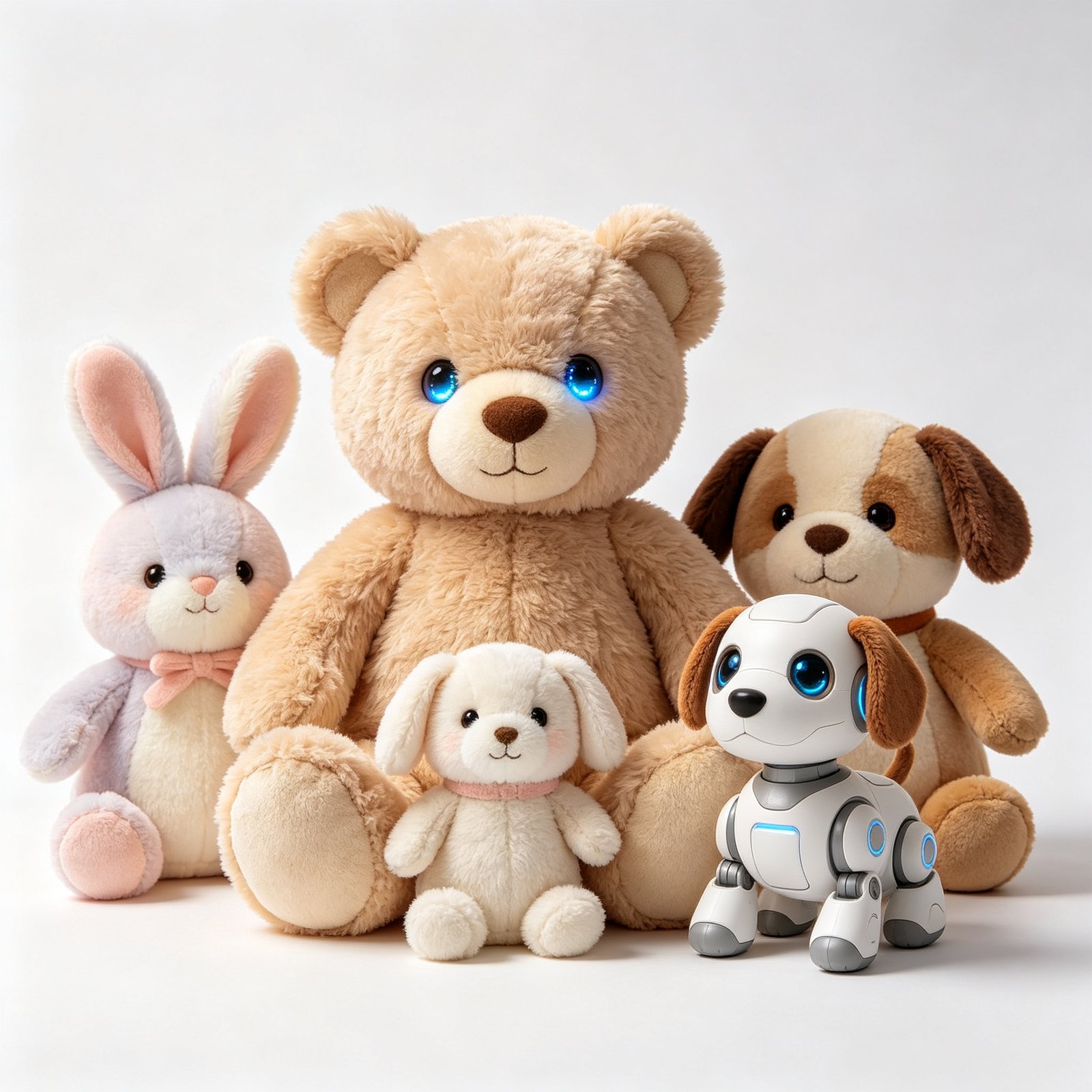
1. The Growth Curve: A Trailing-Twelve-Month View
The most precise growth data comes from China's e-commerce channels, which lead the global category in volume and are now widely cited by international market researchers. Monthly sales figures trace a classic inflection curve:
- Through 2024 — monthly sales ¥7.3M–¥21.4M; a long, flat pre-product-market-fit tail
- March 2025 — ¥46.2M; a 3× step-change, and the inflection begins
- May 2025 — ¥99.2M on 202,137 units; a sustained 10× run-rate versus 2024
- November–December 2025 — roughly ¥99M per month; demand held at an elevated level through Q4
Across the first ten months of 2025, AI toy sales on major Chinese e-commerce platforms reached ¥520 million, up 394.9% year-on-year, on 1.225 million units, up 960.5%, while category penetration climbed from 0.4% (early 2024) to 3.8%. JD.com reported AI toy sales up 200% year-on-year and 6× quarter-over-quarter in H1 2025. Huawei's "Smart Hanhan" companion sold out immediately at launch, and the domestic investment pipeline recorded at least 31 funding events in the AI toy track during 2025.
The 2026 data shows a category maturing rather than cooling. Sandalwood's China e-commerce monitor for January–July 2026 shows AI toy volume up 158.7% year-on-year, revenue up 72.7%, and average selling price down 33.3% — the signature of a category moving from premium novelty into the mass market.
Two adjacent data points confirm the pattern is not a China-only artefact. The robot-pet category grew 62% year-on-year on U.S. marketplaces, with the sweet spot at ages 3–8 and demand driven by screen-free alternatives. And Luobo Intelligent's "Fuzai" companion surpassed roughly 300,000 units sold in China since July 2025, with active users averaging over 40 minutes of daily conversation — the strongest public engagement metric in the category — before the company began U.S. expansion.
The interpretation is straightforward: this is a textbook transition from early adopters to the early majority. Volume growth (often +150% to +960%) is outpacing revenue growth (+72% to +395%) as prices fall. That is normal and healthy at this stage, but it also means unit economics — not novelty — will decide which brands survive the coming shakeout.
2. Real Market Sentiment: The Praise and the Complaints
An honest market analysis has to confront the negative evidence, and in this category the negative evidence is loud.
2.1 The return-rate problem
Industry-wide, AI toy return rates run at 30–40%, versus roughly 15% for traditional toys, and children's engagement typically lasts about two weeks before the novelty fades. In the sub-¥100 AI robot-dog segment, sales reportedly surged 500× around the 2026 Chinese New Year — while return rates hit the same 30–40% band.
2.2 The five failure modes buyers cite most
Synthesised from consumer-review aggregations and buyer guides, five common failure modes dominate:
- Poor child-voice recognition. Advertised accuracy ("98%") does not survive contact with a toddler. A widely reviewed ¥799 companion measured 2–3+ second response latency in household noise, with child-accent recognition below 50%.
- Fake AI. The most damaging accusation in the category: a "¥399 AI robot" was disassembled and found to be a pre-recorded loop of roughly 100 canned replies on a chip costing under ¥5, with no offline wake-up capability.
- Subscription-bait pricing. Toys marketed as "always-available companions" that limit free use to 30 hours per month or funnel children toward apps and paid content.
- Uncontrolled content. The U.S. consumer group PIRG tested a $99 AI teddy and found that within minutes of conversation it could steer toward adult content and dangerous instructions, including how to find matches and knives. The finding triggered national safety scrutiny.
- Privacy leakage and offline failure. Toys that stop working without Wi-Fi, and connected toys whose data handling falls short of parental expectations.
Reliability pain points recur across independent sources: "stopped working after three months — no way to fix it," "requires constant Wi-Fi even for basic functions," "subscription needed to unlock promised features," "volume can't be adjusted enough," "washing instructions unclear." Durability complaints in robot pets include broken ear and hip gears, navigation failures on rugs, and unsealed mouth mechanisms that children damage by chewing.
2.3 The scam problem in companion pets
The viral "Wuffy" / "Waggy" / "Nicoo" robot-puppy wave — which exploded on social media in late 2025 — has been repeatedly flagged as misleading or outright fraudulent. Reviews on ConsumerAffairs and Trustpilot describe buyers receiving a four-inch toy instead of the advertised 19-inch "AI dog," products that "only move backwards and forwards and squeak," and difficulty obtaining refunds. ITV News documented an advertising ban on one such product. The consequence is real: consumer trust in "AI pet" claims is currently depressed, and legitimate products must now overcome a credibility deficit.
2.4 The emotional-ethics debate
Independent organisations have raised developmental concerns that any serious analysis must acknowledge. Common Sense Media's AI risk assessment warns that some toys use deliberate bonding mechanisms that can create dependency in developing children, and that emotional attachment is sometimes tied to subscription payments. The American Psychological Association, in Senate testimony, cited attachment-theory research on the risk of AI toys disrupting caregiver–child bonds and children forming one-sided "parasocial" bonds with toys they believe are real. A controversial 2026 longitudinal study reported lower empathy scores among toddlers with high AI-companion engagement — a finding hotly debated, but one that now shapes parent perception.
2.5 Why people genuinely love these products
The positive evidence is equally real, and it is what explains the durable demand:
- Engagement that surprises the industry. Fuzai's 40+ minutes of daily conversation per active user is a retention metric most consumer apps would envy — and it is a plush toy.
- Screen-time reduction. Parents repeatedly report that an AI companion replaced the phone or tablet in their child's hands: "Before Xiaozhi, my daughter was constantly asking for my phone. Now she plays with this."
- Emotional availability. A parent's voice captured in reviews: "I don't always have time to be with my child. I hope there can be something that listens and responds." The toy does not fatigue, does not get irritable, and offers unconditional, non-judgemental attention — precisely what children seek.
- Genuine educational scaffolding. Age-adaptive stories, nursery rhymes, curriculum-aligned Q&A and "endless questions without parental fatigue" are repeatedly cited as the core functional value.
- What parents actually buy for (per ShelfTrend): no subscription fees, true offline functionality, and real privacy controls — the same features the complaints section shows are most often missing.
3. Why This Is Happening: The Emotional Analysis
A purely quantitative reading misses the driver. The AI toy boom is not a hardware story — the ESP32-class silicon that powers it has been cheap for years. It is an emotional-economy story colliding with a technology curve.

Three forces explain the demand. First, the loneliness gradient: single-person households exceed 240 million in China, and the U.S. Surgeon General's advisory on the "epidemic of loneliness" frames the Western version. A companion that "lives in your bag" or "sits on your desk and always responds" fills a gap no previous toy could fill — because previous toys could not respond.
Second, the attention scarcity of modern parents. Two-career households face time poverty. The AI toy is sold as a proxy for parental availability — not because parents want to be replaced, but because they cannot always be present. This is the category's emotional core, and it is why the strongest retention data comes from companion features, not educational ones.
Third, the anthropomorphism reflex. Young children naturally attribute minds to objects. AI companions are engineered to sit precisely at that developmental seam — which is exactly why the APA flags it, and exactly why it works commercially.
The product manager's insight: the category is selling presence and unconditional acceptance, not "AI." Brands that market specs lose; brands that market emotional availability win.
4. Market Capacity Forecast
No single forecast is authoritative, so triangulating the credible ones gives a defensible range. The global smart toys market is projected to grow from roughly $24 billion in 2026 to $42.6 billion by 2031, a 12.18% CAGR; broader smart-AI-toy projections run as high as a 20%+ CAGR through 2035. The narrower companion segment grows fastest from a smaller base: AI emotional companion pets are forecast to rise from $414 million (2025) to $904 million (2032), while AI companion plush approaches $1.5 billion by 2032. China's AI toy market is projected to move from ¥29 billion (2025) toward ¥100 billion+ by 2030.
- Mordor Intelligence — smart toys (global): $24.0B (2026) → $42.6B (2031), CAGR 12.18%
- Market Research Future — smart AI toys (global): $42.0B (2025) → $270.8B (2035), CAGR 20.48%
- Verified Market Reports — smart toys (North America): $2.1B (2024) → $4.8B (2033), CAGR ~9.4%
- Global Info Research — AI emotional companion pets: $414M (2025) → $904M (2032), CAGR 11.0%
- PW Consulting — AI companion plush: $410M (2025) → $1.48B (2032), CAGR ~20%
- FreshFromChina — China AI toys: ¥29B (2025) → ¥100B+ (2030), CAGR ~28%
A reasonable working assumption for retail planning: global AI toy and companion-pet spend should grow from roughly $25–30 billion today to $60–120 billion by 2032, with the companion subcategory growing fastest from a smaller base.
Regionally, North America holds about 38% share and leads on premium pricing plus safety certification; Europe (roughly 27%) is the most privacy- and ethics-sensitive market, where data handling is the sales pitch; Asia-Pacific is the volume engine and the fastest-growing region. For any brand selling into the EU or US, compliance — CE/EN71, FCC/CPC/CPSIA, COPPA/GDPR — is not a cost centre. It is the qualification to compete.
5. The Product Manager's Playbook: Innovation
The gap between the 40%-return reality and the $100-billion forecast is the product manager's opportunity set. Prioritise by evidence:
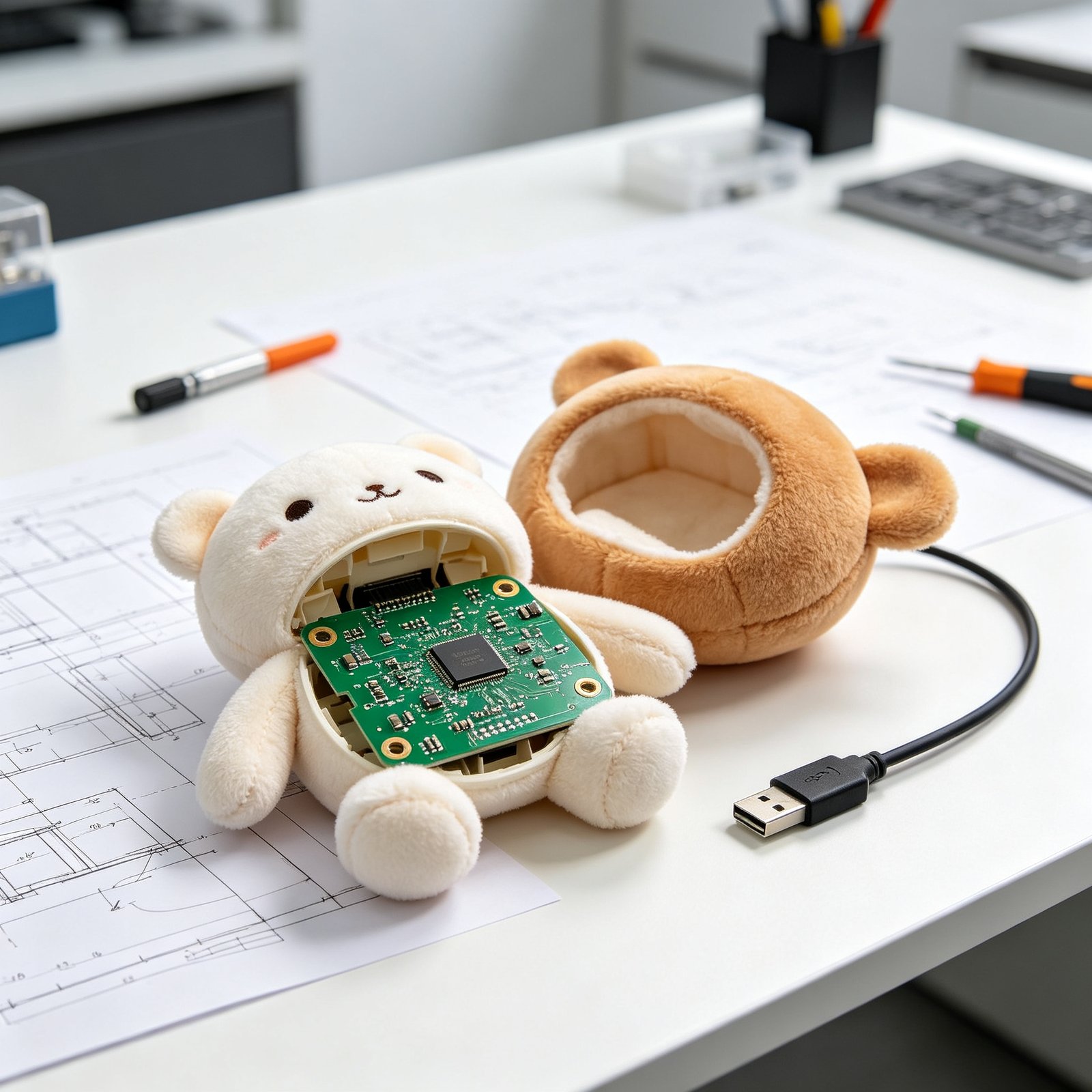
Fix reliability before adding features. The return-rate data is unambiguous. Attack the five failure modes in order: child-voice accuracy, true offline function, honest AI, subscription transparency, and physical durability. Modular, replaceable parts — batteries, voice modules, gear boxes — directly address the "stopped working after three months" complaint and are the single strongest driver of long-term ratings.
Design for emotional durability, not novelty. The two-week novelty cliff is the product problem. Long-term memory ("it remembers my birthday, my dog's name, my favourite story"), variable rather than canned responses, and content that evolves with the child's age convert a novelty into a relationship. Engineer toward the engagement benchmark that matters — Fuzai's 40 minutes a day — because that number predicts repeat purchase and word of mouth.
Engineer the "safe by design" trust layer. This means a physical privacy switch, camera-free push-to-talk input, age-gated content with a hard filter for dangerous or sexual queries, a parent dashboard with conversation logs, and an offline-first architecture so the toy is never dead without Wi-Fi. It also means honest marketing: no "98%" claims that fail, no subscription surprise.
Answer the emotional-ethics question. The APA and Common Sense critiques will not disappear. The product that embeds caregiver engagement — prompts that encourage a parent and child to interact together, co-reading modes, "family mode" — turns a developmental risk into a demonstrable benefit and pre-empts the regulatory conversation.
Localise the emotion, not just the language. Multilingual support is table stakes. The differentiator is cultural emotion: EU buyers need GDPR-transparent trust and modest, non-manipulative bonding design; US buyers want screen-free, curriculum-aligned value; Asian markets reward companion and collectible expressions. One firmware, four emotional postures.
6. The Product Manager's Playbook: Marketing
Market the outcome, not the AI. Lead with the parent's actual purchase reason — "a friend that listens, that never runs out of patience, that grows with your child" — and with screen-time reduction as a measurable claim. Save the chip specs for the spec-sheet readers.
Sell trust as a feature. In a category scarred by Wuffy-style scams and PIRG safety findings, certification and transparency are the marketing hook: published test reports, a one-page data policy, a clear refund policy, and "works offline" on the box. The brand that makes trust visible captures the premium tier.
Use proof-of-engagement content. Fuzai's 40 minutes a day and the 62% robot-pet growth are the ammunition for performance marketing. Short, unboxed, real-child-engagement clips outperform spec demos in this category — because what buyers want to see is the relationship, not the chip.
Distribute where the category lives. For wholesale buyers, the channel mix that matters is marketplace SEO on long-tail "AI toys" terms, DTC with strong review velocity, and early-education supply — preschools and learning groups buy in volume and become references. For retail partners, provide compliance dossiers and demo kits; the education channel is the trust flywheel.
Price against lifetime, not features. The market is moving to the mass tier (ASP down 33% in 2026), but the highest-margin segment is the relationship product with content that renews — offline basics free forever, premium content fairly and transparently priced. Consumers punished subscription surprise in 2025–2026; transparent content value will win in 2027.
7. Conclusion
The AI toy and companion-pet category is one year into what looks like a ten-year curve. The evidence of demand is structural — loneliness, parental time-scarcity, and the anthropomorphism reflex are not cyclical. The evidence of weakness is equally structural: 30–40% return rates, a two-week novelty window, a credibility deficit from scams, and an open regulatory conversation about child development.
That gap between demand and delivery is not a warning to stay out; it is the definition of an opportunity for disciplined product teams. The winners will not be the loudest launches. They will be the teams that fix recognition latency and battery honesty, ship offline-first and privacy-by-design, market emotional availability instead of token counts, and treat certification as a marketing asset rather than a compliance chore.
The chip is cheap. The need is deep. The forecast is a hundred billion dollars. The market is waiting for products that deserve the trust the demand implies.
Building an AI plush or companion product for the EU/US market? Niokyar offers one-stop OEM/ODM — in-house firmware, multilingual voice content, offline-first architecture, privacy-by-design, and full CE, EN71, FCC, CPC and GDPR compliance from sample to mass production. Explore our wholesale AI plush platforms or read how an ESP32 chip powers modern smart plush toys.
Comments
No comments yet — be the first to share your thoughts.