2026-09-12
Reese's Law in Your Pocket: Button-Battery Compliance for AI Toys in 2026
A button-cell battery that a curious toddler can pry out in ten seconds is no longer a manufacturing oversight. Since October 2023 it has been a federal violation in the United States, and AI toys — with their glowing chests, LED eyes and pocket-sized bodies — are exactly the product type that puts buyers on the wrong side of it.
This is not a safety lecture. It is a compliance checklist that protects your shipments from detainment at customs, your brand from a recall notice, and your margin from the cost of redesign.
What Reese's Law Actually Requires
Reese's Law, enacted in 2022 and implemented by the Consumer Product Safety Commission (CPSC), incorporated ANSI/UL 4200A-2023 as the mandatory safety standard for consumer products containing button or coin cell batteries. The rule is codified at 16 CFR Part 1263 and has applied to products manufactured or imported on or after 23 October 2023.
The core requirement is simple to describe: the battery compartment must resist child access. UL 4200A permits two acceptable methods:
- Tool method. The compartment requires a screwdriver, coin or other tool to open.
- Two-movement method. The compartment can be opened by hand, but only using two independent simultaneous actions.
A child-age test protocol is part of the standard: a panel of toddlers attempts to open the compartment, and it must remain closed under defined test conditions. Labeling requirements on the product and packaging are also specified. The CPSC business guidance page is the authoritative source.
Why AI Toys Are the Highest-Risk Product Type
AI toys combine three factors that regulators care about: a young user, a small electronic device that needs power, and a marketing story built around touch, squeeze and hug interaction. The plush shell invites a child to manipulate the product exactly where the battery lives.
Three design choices make the difference between a compliant product and a recall letter:
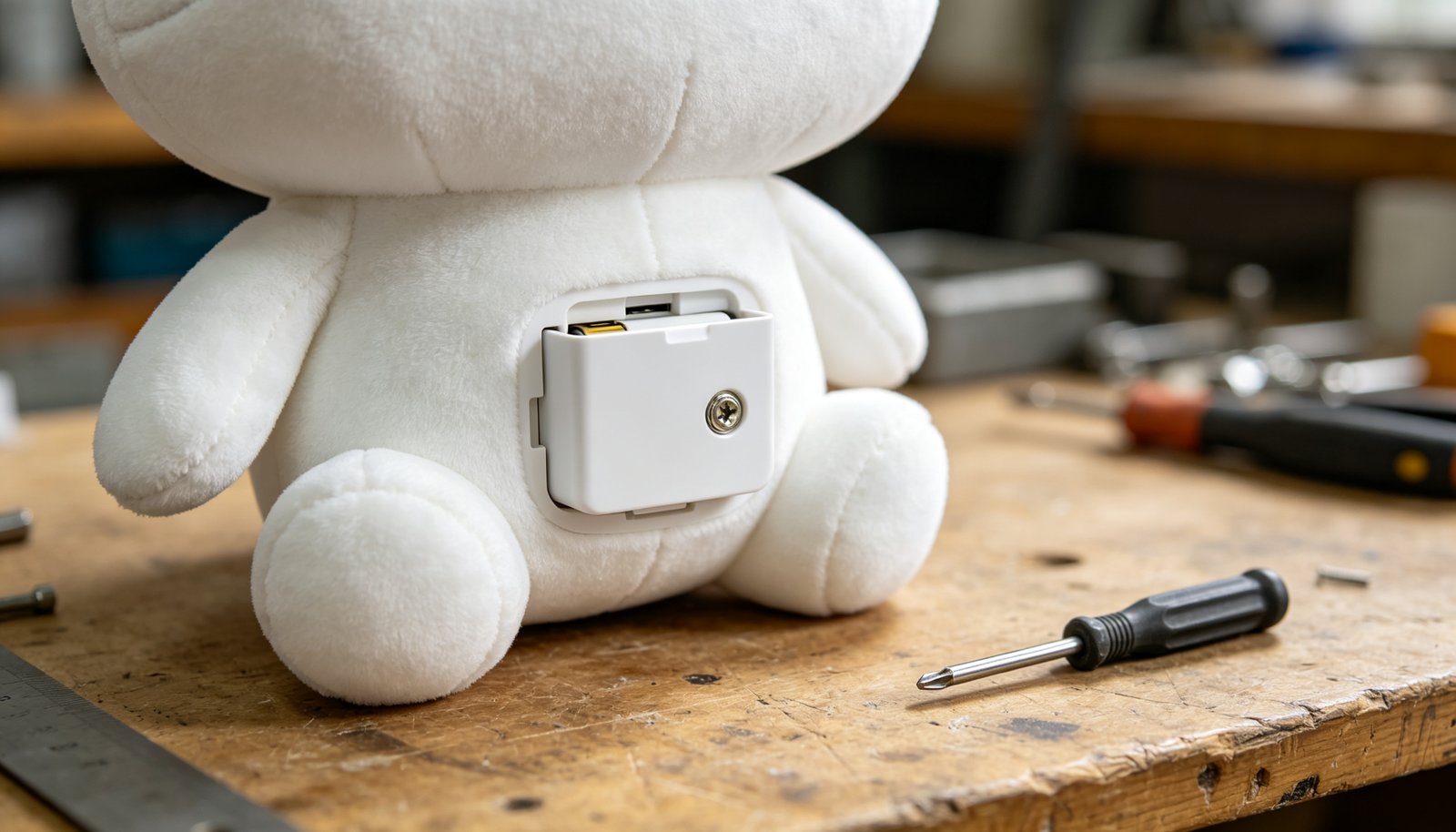
- Screw-secured compartments. The simplest, lowest-risk option. A single captive screw that a child cannot remove with fingernails is the default.
- Rechargeable packs instead of user-replaceable cells. If the product runs on a sealed Li-ion or Li-po pack charged over USB, it removes the button-cell risk entirely. This is the direction most modern AI plush designs take.
- Tamper-evident battery doors. Even when a tool is required, the compartment must survive drop, torque and prying tests.
The UL 4200A standard overview details the test methods.
The ASTM F963 Intersection
There is one nuance that buyers often miss. UL 4200A does not apply to toys that already comply with the battery-accessibility and labeling requirements of ASTM F963, the general toy safety standard. In practice, this means two compliance paths exist:
- Path A: A toy that already meets ASTM F963 battery-access provisions is considered covered for button cells.
- Path B: A product that is not a toy under the CPSC definition — for example, an adult desk companion or a pocket device marketed to older users — must still meet UL 4200A directly.
This matters when your AI product crosses the line between "children's toy" and "consumer electronics." The regulatory path changes with the age label and the marketing claim. A factory that understands both standards is worth more than a cheaper one that only knows one.
The Buyer Checklist Before You Place an Order
Do not accept a supplier's verbal assurance that the product is "Reese's Law compliant." Ask for the following in writing:
- A test report from an ISO 17025 accredited lab showing UL 4200A or ASTM F963 battery-access results.
- Photographs of the battery compartment in both closed and tool-opened state.
- The exact screw type and whether it is captive.
- Packaging artwork showing the required warning labels in English.
- Confirmation that the product uses either a sealed rechargeable pack or a screw-secured user-replaceable compartment.
If any of these are missing, the product can still be good — but it is not yet shelf-ready for the United States. Budget for the redesign and retest before you quote a retail price to your customer.
What Niokyar Designs In From Day One
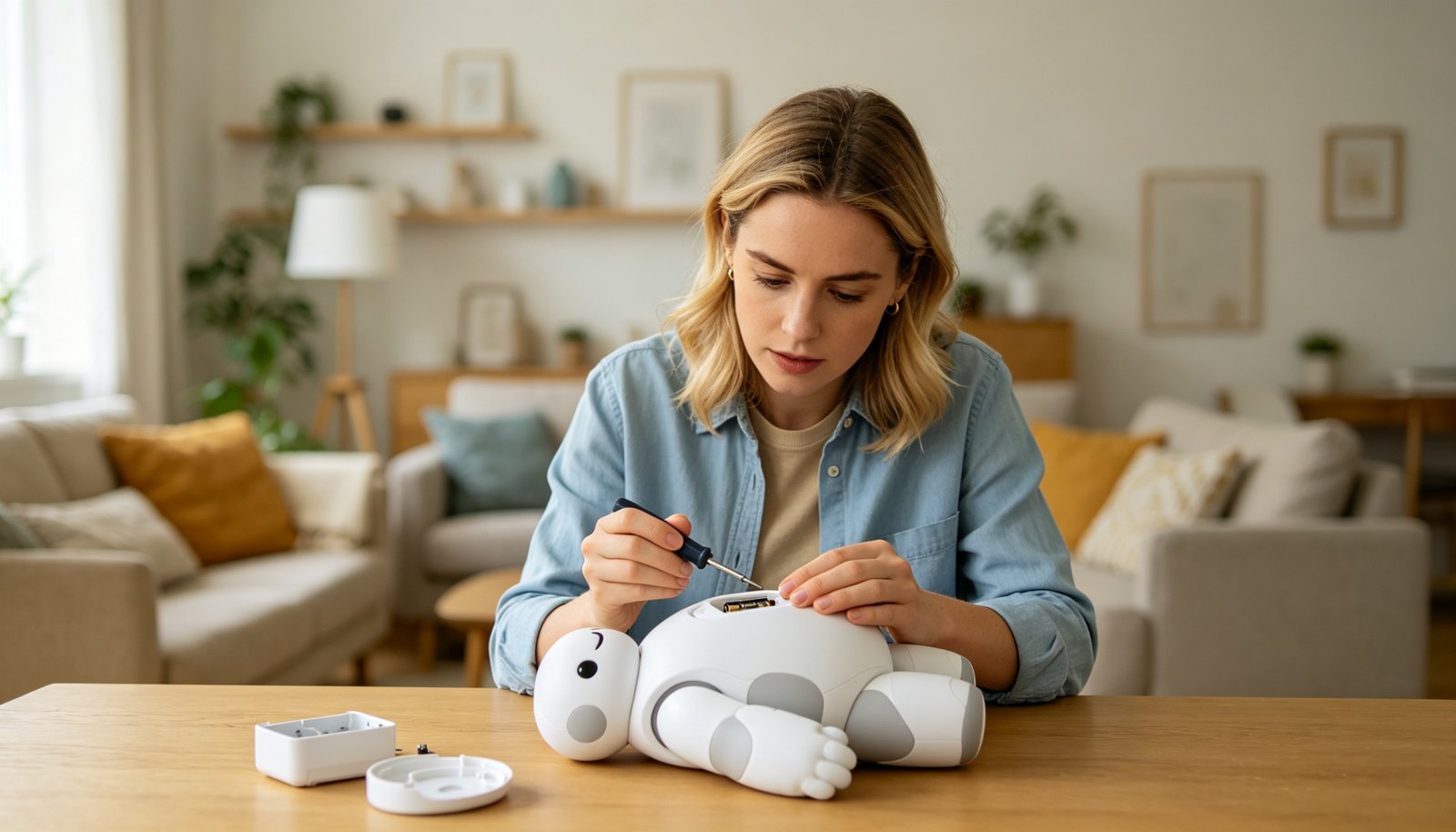
Compliance is not a final-engineering sticker at Niokyar. It is part of the industrial design input. Every AI plush, pocket companion and desk robot we design is evaluated against the battery-access path early, because redesigning a battery compartment after the tool is cut is where margin goes to die.
We work with accredited laboratories on UL 4200A and ASTM F963 testing, supply the test reports and packaging labels your buyers expect, and can switch between sealed-pack and screw-door configurations depending on your target retail price and age band. Whether you are sourcing a children's plush or an adult desk companion, the compliance file travels with the sample.

Frequently Asked Questions
Does Reese's Law apply to AI toys sold outside the United States? No. Reese's Law is US federal law. The EU and UK have their own toy safety frameworks (EN 71 and UKCA), which address small parts and battery access through separate clauses. A product can be Reese's Law compliant without being fully CE compliant, and vice versa.
Can I sell an AI toy that uses a rechargeable Li-po pack? Yes, and this is the cleanest path. Sealed rechargeable packs are not button-cell or coin-cell batteries, so the UL 4200A battery-door requirements do not directly apply. The product must still meet general electrical safety and battery transport standards (UN 38.3).
What happens if my product is detained at customs? CBP can hold shipments that lack required children's product certificates or test reports. The typical resolution is supplying the missing documentation within 30 days, after which the shipment is released or destroyed. Preventing the hold is far cheaper than fighting one.
Can Niokyar help me redesign an existing product to be compliant? Yes. Send us the existing sample or drawings, and we will return a compliance gap analysis covering battery access, labeling, packaging and the test path, typically within one week.
Comments
No comments yet — be the first to share your thoughts.