2026-10-20
The $0.30 Part That Decides Your AI Plush Toy's BOM: How MEMS Microphone Choice Drives Wake-Up Accuracy, Voice Quality and Certification Cost
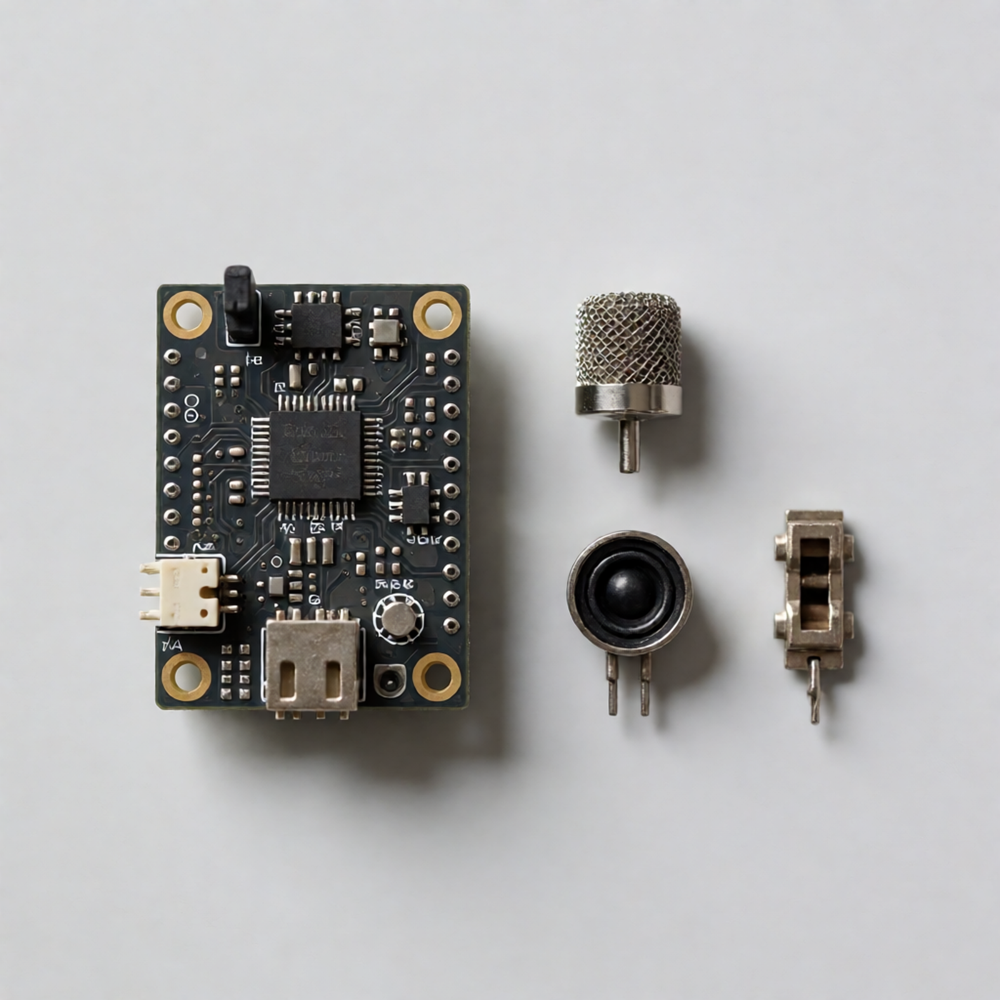
Ask any buyer what makes an AI talking plush toy work, and the answer is usually about the model: the chatbot, the voice, the personality. Ask a product engineer and the answer is closer to the microphone. A toy can have an excellent model and still be loved or hated entirely on whether it woke up the first time a child spoke to it.
The MEMS microphone is the cheapest component in that chain and the one whose specification most affects the outcome. It typically lands between $0.20 and $0.60 in volume, yet the way it is chosen and mounted decides wake-up accuracy, how well the toy understands a four-year-old talking from two metres away, and how much time you spend chasing certification failures late in the project.
This is the buyer-level guide to that part: what the numbers on the datasheet actually do for your product, what each upgrade buys, and which lines belong in your purchase order before you commit to a tooling deposit.
The Three Gates Every Voice Plush Toy Has to Pass
A talking plush toy is graded on three things in sequence, and the microphone sits at the front of all of them.
- Did it wake up? The wake word has to be detected from standby power, through fabric, with television noise in the room. Miss this and the product feels broken.
- Did it understand? Once awake, the utterance has to arrive at the recogniser cleanly enough to transcribe. This is a signal-to-noise problem that the microphone either helps or destroys.
- Did it stay inside the budget and the compliance envelope? The microphone choice affects standby current, part count, mechanical opening size and, indirectly, your EMC and safety test outcomes.
Most of the time a small microphone is "good enough". The point of this guide is the minority of the time when it is not, and how to know before you have paid for 300 or 5,000 pieces.
What the Datasheet Numbers Actually Buy You
Four specifications on a MEMS microphone datasheet do real work in a plush toy. The rest are secondary.
Signal-to-noise ratio (SNR)
SNR is the microphone's own self-noise measured against a reference level, expressed in dB. It sets a ceiling: no amount of post-processing recovers detail the microphone never captured. A 58 dB part and a 64 dB part differ by roughly the noise floor of a nursery, and that difference is visible in recognition accuracy in a room with a TV on.
What it costs: moving from the entry tier (58–60 dB) to the mid tier (63–66 dB) typically adds a few cents per part in volume. It is one of the highest-value upgrades in the entire electronics bill of materials, because it is almost purely a part-selection decision with no mechanical redesign.
Acoustic overload point (AOP)
AOP is the loudest sound the part can take before it distorts. A child shouting directly into the toy, or a speaker mounted in the same enclosure, can exceed a modest AOP. When AOP is exceeded, the incoming audio clips, the recogniser gets garbage, and the failure looks intermittent and impossible to reproduce in the lab.
What it costs: usually nothing to a few cents. The specification question is free; the symptoms if you get it wrong are a support ticket you cannot close.
Low-power and standby modes
Offline wake-word detection needs the microphone running at microamp-level current while the toy is otherwise asleep, so standby battery life and daily activation rate can both be traced back to this. A part with a proper low-power mode and a clean sleep/wake transition keeps the toy alive for days; a part without it either drains the battery or forces the designer into a hardware workaround.
What it costs: this is where the cheap part gets expensive. If the chosen microphone forces a larger battery or a more expensive power-management circuit, the few cents saved on the microphone reappear as dollars elsewhere.
Package and acoustic porting
The microphone is a tiny mechanical device with a hole in it. How that hole is aligned to the fabric, how it is sealed against the stuffing, and how much of the enclosure it opens all decide whether the excellent SNR on the datasheet survives contact with a stuffed animal.
What it costs: no part cost, real tooling and process cost. This is where the "noise" in a plush toy actually comes from — not from the microphone, but from the path between the child's mouth and the microphone's port.
Where the Real Problems Are: Acoustics, Not Silicon

In a plastic toy, acoustic design is a housing question. In a plush toy it is a soft-goods problem, and that changes everything about how the product fails.
Four failure patterns account for most of the microphone complaints we see in plush projects:
- Fabric mutes the port. A dense or double-layer plush fabric over the port attenuates the high frequencies that carry consonant information. The toy wakes up but mishears. The fix is a designed opening or an acoustic mesh, decided at pattern stage — not after sampling.
- Stuffing shifts during play. Unlike a moulded housing, a stuffed toy moves. Fibre filler that migrates over the port creates a slow, unpredictable degradation that customers experience as "it got worse over months".
- The speaker talks into the microphone. The voice output and the microphone share the same soft enclosure with almost no internal baffling. Echo and self-triggering during playback are a design consequence, not a firmware bug.
- Seam placement adds a second port. A stitch line adjacent to the microphone port leaks sound pressure around the intended opening, changing the acoustic response in a way that depends on how tightly each unit was stuffed. Unit-to-unit inconsistency in voice performance almost always starts here.
All four are cheap to fix at the pattern and pilot-run stage and expensive to fix after a production run. This is exactly why a factory that cuts the pattern, embroiders, sews and mounts the electronics under one roof has an advantage on voice products: the acoustic engineer and the pattern maker are the same team, adjusting the same sample on the same table.
Seven Spec Lines for Your Purchase Order

Vague microphone requirements produce whatever the factory had in stock. These seven lines, written into the PO, make the part and its integration auditable:
- Microphone class and SNR floor — state the minimum SNR, not a part number. It leaves sourcing room while protecting the acoustic outcome.
- AOP minimum — prevents clipping from close-range speech and from the toy's own speaker.
- Low-power mode current and wake latency — ties directly to your stated standby and daily-activation claims.
- Acoustic port design and sealing — a drawing, not a description: port diameter, mesh specification, sealing method, and the fabric layers permitted over it.
- Unit-to-unit consistency test — how many units per batch are wake-word tested, at what distance and against what noise floor. Ten units at 60 dB ambient is a different claim from ten units in a quiet room.
- Hardware mute verification — if the toy has a mute switch, the PO should require that it physically interrupts the microphone, and that the effect is tested on the batch.
- Change control — any substitution of microphone, mesh or port geometry requires buyer approval with a new sample. This single line prevents the most common quiet downgrade in a long production run.
The BOM Arithmetic: What Cents Buy
The useful way to think about this part is not "how little can it cost" but "what does each cent buy, and what does each saving cost later".
At the entry tier, a 58–60 dB microphone plus minimal acoustic design will pass a quiet-room demo and struggle in a real living room. At the mid tier, 63–66 dB with a designed acoustic port and a tested mute path, you are buying a toy that behaves the same on the first day and the sixtieth. The difference in parts cost is small; the difference in returns, support load and reviews is not.
Three cost traps worth naming:
- Saving on the microphone and scaling up the battery. A part without a usable low-power mode pushes the whole power architecture up. The microphone saving is real, the battery, enclosure and certification cost is larger.
- Skipping the pilot acoustic validation. A short validation on real samples costs a few days. Discovering the port issue after production costs a rework cycle and, on a small order, the entire margin.
- Treating mute as a firmware feature. A software-only mute is the single most common compliance and trust failure in this category. A hardware interrupt is a few cents and a drawing; it is also the first thing an experienced buyer checks.
Why This Part Belongs in the Low-MOQ Conversation
Small orders and voice products interact badly when the supply chain is fragmented. The microphone supplier, the module supplier, the sewing house and the lab that validates the acoustic behaviour are four separate calendars, and each of them can hold the others up. On a 300-piece run you cannot afford three sampling rounds simply because two suppliers disagree about a port diameter.
This is the same argument we made in our breakdown of why 300 units cost more per piece than 5,000: the coordination cost is real, and it is largest exactly where the interfaces are least specified — fabric to port, module to cavity, speaker to microphone. A single-source supply chain does not make the microphone cheaper. It makes the acoustic decision happen once, in one place, before tooling.
What to Do Before You Approve Tooling
- Ask for the microphone class and the SNR floor, in writing.
- Ask for the acoustic port drawing and the mesh specification.
- Ask how many units per batch are wake-word tested, and under what noise conditions.
- Ask whether mute is a hardware interrupt, and see the test record.
- Run the acoustic validation on real, stuffed, sewn samples — never on a bare board.
None of these questions require technical depth to ask. All of them separate a factory that has shipped voice plush toys from one that is estimating.
For the cost side of the same conversation — tooling, fabric minimums and where small runs pay for themselves — see our AI toy mould cost breakdown.
Sourcing an AI talking plush toy or a voice-enabled companion product? Tell us your target markets, the interaction you have in mind, and your order size, and we will come back with a microphone and acoustic specification matched to it — plus a sample plan.
Comments
No comments yet — be the first to share your thoughts.