2026-10-29
The One-Day AI Toy Factory Audit: Eleven Questions and the Documents That Expose an Assembler
Every importer eventually has the same conversation. You have a shortlist of three plush AI toy factories, all of them answer your RFQ within a day, all of them send a sample that talks back, and all of them quote a similar price. Then you fly to Guangdong, walk into the first workshop, and realise you have no idea what you are supposed to look at. The showroom looks the same as the last one. The samples are the same samples. The difference between a factory that will deliver a consistent container and one that will hand you a recall notice only shows up in places most buyers never open.
This guide is the practical version of that inspection. It is written for importers, distributors and brand owners sourcing AI plush toys, companion robots or learning tablets, and it focuses on the checks that are specific to voice-enabled toys: where the speaker sits, what happens when the battery swells, who holds the microphone data, and how the certificate of conformity matches the unit you are actually buying. Every regulatory point below is referenced to the current text so your quality team can verify it.
Why factory selection matters more for AI toys than for conventional plush
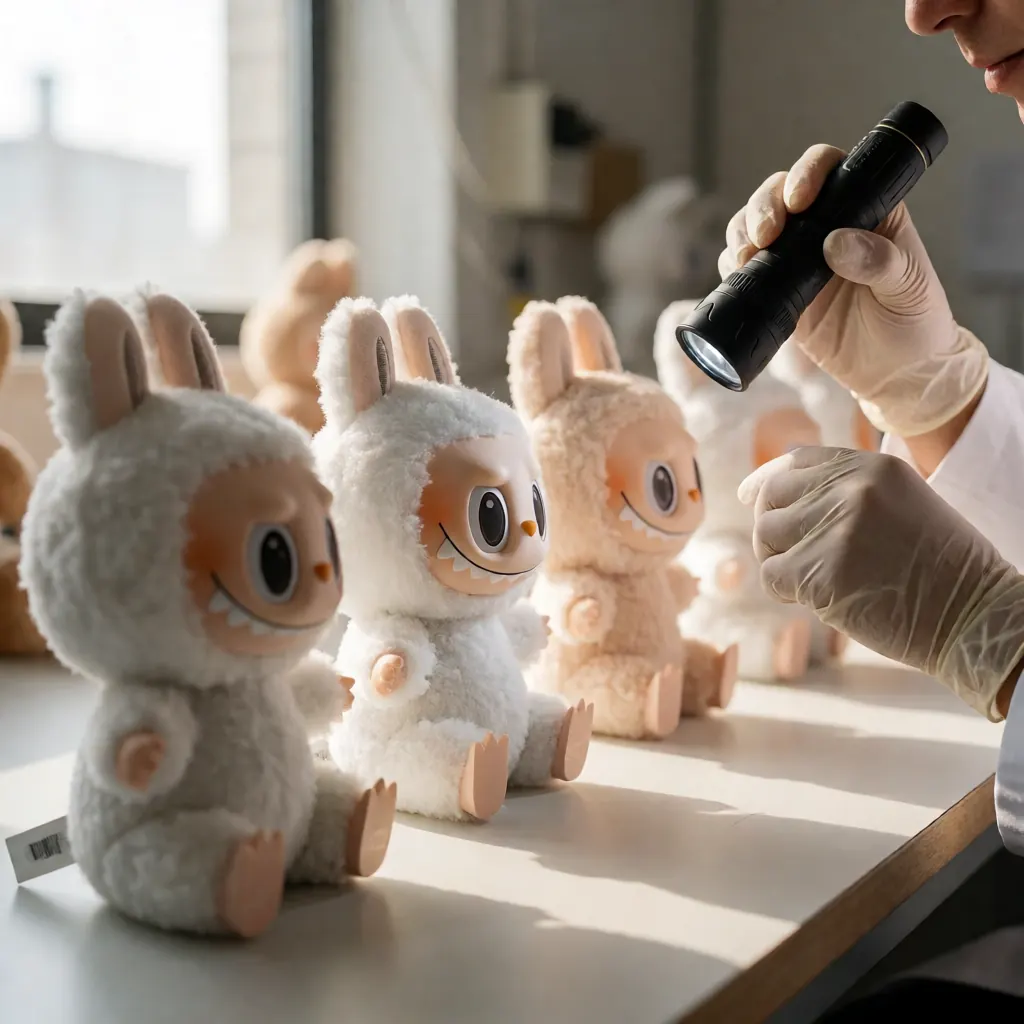
A conventional plush toy is a textile product with a safety perimeter: seams, filling, small parts, flammability. A voice-enabled plush toy is a textile product wrapped around a radio transmitter, a microphone, a rechargeable battery and a cloud account. The failure modes multiply, and most of them are invisible at the sample stage.
Three things make this category harder than it looks.
- The compliance perimeter has widened. Under the US toy safety standard, each toy must comply with ASTM F963-23, incorporated by reference in section 1250.2 of 16 CFR Part 1250, and that rule also now addresses specific hazards such as water beads and neck floats. An AI toy adds a battery, wireless equipment and software on top of that base.
- The certificate is not the certification. A Children's Product Certificate is a written statement by the importer that specific tests were completed; its required contents are set out in section 1110.11 of 16 CFR Part 1110. As we will see, the gap between what the certificate says and what was tested is where most recalls begin.
- The data obligation belongs to the brand, not the factory. If the toy is directed to children under 13 in the United States, the operator must give notice and obtain verifiable parental consent before collecting personal information, per section 312.4 of 16 CFR Part 312, and follow the related requirements in sections 312.3 and 312.5. A factory that says "we store audio in the cloud" without telling you where has just handed you a liability you cannot measure.
None of this means AI plush toys are a bad category. It means the vetting questions have to change.
The sample suitcase test: open the seam before you trust the sample
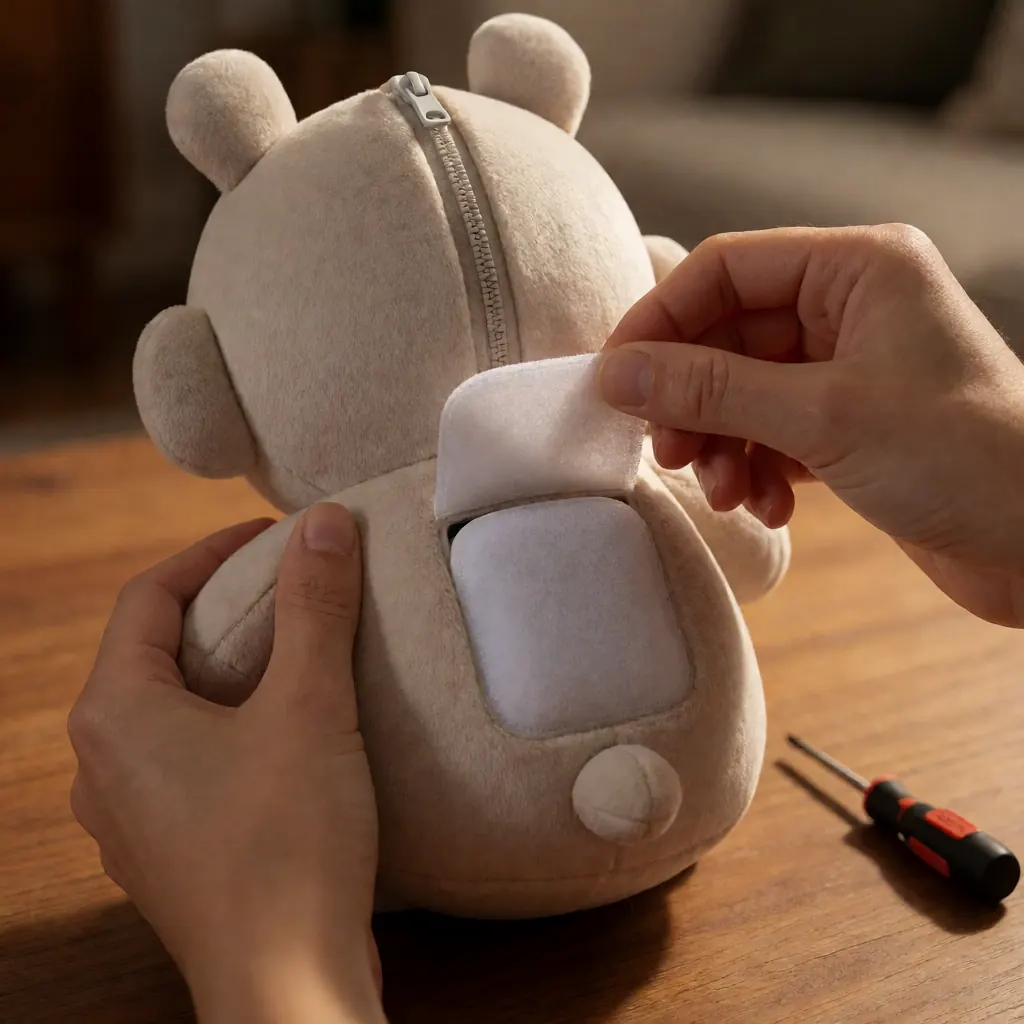
Ask the factory to send samples with an intentionally unsewn back seam, or bring a seam ripper to the audit. A plush toy you cannot open is a plush toy you cannot inspect. This is the single highest-value three minutes in a factory visit.
Inside the shell you are checking four things, in this order.
- The electronics module and its fastening. Industrial-grade assemblies use a molded housing that is either screwed to a bracket or sewn into a dedicated compartment. A module that floats loose in the filling will migrate under squeezing, which is exactly what a child does to a plush toy. Loose modules are also the leading cause of wire fatigue at the solder joints.
- The speaker and microphone placement relative to the seam and face. The microphone should sit behind a defined acoustic opening, not taped to the back of the fur. If the mic is buried in polyester fill, every wake-word false reject you see in a living room is a design decision made at the factory floor.
- Battery access and replacement design. Whether the cell is replaceable or sealed, you need a documented access route with a fixed tool, and a clear statement that the compartment cannot be opened by a child. Swelling, thermal and puncture behaviour are the difference between a field issue and a headline.
- Wire routing and strain relief. Look for cable ties or channel routing, and check whether the wires cross a seam that flexes when the toy is hugged. Wires that cross a flex point without a service loop fail at month four, after your stock has shipped.
On the production line, the equivalent check is a first-article inspection: one full unit dissected and photographed against the approved construction drawing, kept as the reference sample for the life of the order.
Eleven questions that separate an assembler from a real OEM
Ask these in writing and insist on written answers. A factory that answers six will still be useful. A factory that answers all eleven with specifics, including numbers and document names, is the one to visit first. Ask them in the order below and watch which ones are answered quickly versus which ones are answered vaguely.
- Which parts do you make in-house, and which are bought in? Sewing, stuffing, and final assembly in-house is normal. PCBA, firmware and cloud in-house is rare. What you want to know is which supplier sits behind each component, and whether the factory can name the module vendor on request.
- Who owns the firmware and the wake-word model? If the answer is a third-party ODM platform, ask for the platform's data processing terms before you sign anything. If the factory writes its own, ask for a firmware version control procedure.
- Can you show a current test report for the exact model, not the category? The report should name the model or SKU, the standard, the lab, the date and the sample count. Be suspicious of a report dated before your last engineering change.
- Who signs the Children's Product Certificate, and can I see a completed one? The importer is legally the certifier, but the factory should be able to produce a template that already lists each rule, ban, standard or regulation separately, along with a GTIN, UPC or SKU and a records contact with an email and phone number. That is the structure required by section 1110.11 of 16 CFR Part 1110.
- How do you control the bill of materials when a supplier changes? Ask how a component substitution becomes a new part number, and whether the customer is notified before or after the switch. Substitution after the switch is how a compliant toy becomes an uncertified one.
- What is your acoustic test, and at what distance? A useful answer names a test distance, a playback level and a pass threshold. An answer of "we listen to it" tells you the demo room is the only place the toy was ever tested.
- Where does the audio go, and how long is it retained? Ask for the data flow on one page: on-device, factory cloud, or a third-party voice platform. Then ask for deletion behaviour when a parent withdraws consent, which is the requirement the COPPA rule attaches to review and refusal rights in 16 CFR 312.6.
- What is your battery plan, and what happens if cells are delayed? Ask which cell supplier, which capacity tolerance, and whether cells are bought against your forecast or against the factory's pooled inventory. Pooled inventory is cheaper and less traceable.
- What is the real lead time from purchase order to ex-works, broken down by stage? Ask for the split between material lead time, sewing, electronics programming, ageing test and packaging. A single number hides the bottleneck, which is usually battery allocation or certification, not sewing.
- What is your minimum order, and can it be split across colours or SKUs? A genuine low-MOQ capability is a supply chain decision, not a discount. If the factory can run small batches, ask how it handles fabric dye-lot minimums, because fabric is often the real floor, not the sewing line.
- Who handles field failures, and what is your replacement rate? Ask for the last twelve months of return reasons by category. A factory that tracks this by code can tell you whether its top defect is audio, charging or stitching. A factory that cannot is guessing, and so are you.
What a real certification package contains
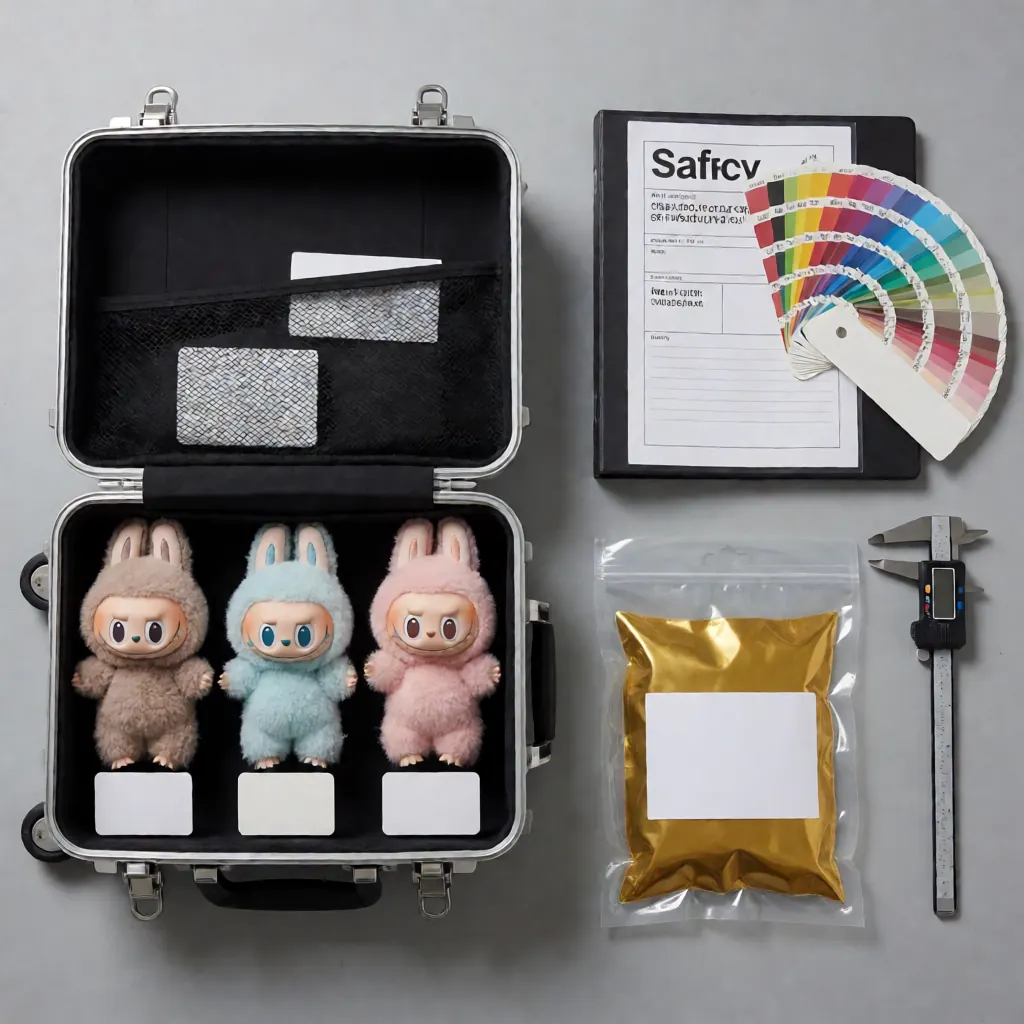
Certification questions are where optimistic suppliers are exposed fastest, because documents either exist or they do not. Ask for the package, not the summary. Here is what a complete package should contain for a US-bound, voice-enabled plush toy aimed at children under 12.
Toy safety test report
- What it should show: ASTM F963-23, exact model or SKU, lab name, sample count, test date
- Where buyers get caught: Report covers the platform design, not your changed fabric or speaker
Children's Product Certificate
- What it should show: Each applicable rule listed separately, plus GTIN, UPC or SKU, certifier details and records contact
- Where buyers get caught: One blanket line covering multiple rules, or a missing records contact
Lead and substrate test data
- What it should show: Painted and printed surfaces and substrate materials, with lab certificates
- Where buyers get caught: Sewn-in substrate never tested because it is not a painted surface
Battery and charging documentation
- What it should show: Cell specification, UN 38.3 transport report, charging circuit description
- Where buyers get caught: Cell spec sheet from a different capacity than the shipped cell
Radio equipment approval
- What it should show: FCC equipment authorisation for the module, with the exact module part number
- Where buyers get caught: Module approval reused after a firmware change that alters the radio parameters
Data and privacy documentation
- What it should show: Data flow diagram, notice text shown to parents, consent mechanism, retention and deletion policy
- Where buyers get caught: Privacy policy written by the factory with no link to the brand's own obligations
Two details deserve special attention. First, the toy safety standard is mandatory and current, so any reference to an older edition of ASTM F963 in a quotation is a red flag rather than a typo. Second, a certificate of conformity is a statement of finished product compliance, and the CPSC general certificate requirements sit in 16 CFR Part 1110; if your supplier has never heard of the rule's required fields, they are not managing your compliance file, you are.
For the EU side, the framework is the Toy Safety Directive and the General Product Safety Regulation, and both are best checked on the Commission's own toys and product safety pages rather than on a supplier's slide. The practical takeaway for a Chinese factory audit is that you ask for the notified body number, the standard used, and the language of the manual for the exact member states you sell into, because a German market entry requires far more than a CE mark on the carton.
The packing test is the recall test
Recall notices almost always read the same way: the toy was fine as designed, but a component came loose, a magnet escaped, or a battery compartment opened under the wrong test. Those are not design errors in most cases, they are verification gaps. The factory that catches them is the factory that physically tests packaging, because packaging is what carries the age warning, the choking hazard statement and the manufacturing batch code that lets you trace a container in a recall.
Walk the packing line and look for four things.
- Batch coding. Is there a printed or laser batch and date code on the toy itself, and does it match the carton and the inner box? If the traceability only exists on the outer carton, a recall will force you to recall the entire shipment.
- Age grading consistency. The age grading on the packaging must match the test report and the performance requirements that applied. A toy graded 3 years and up but tested under the under-36-month requirements has a documentation conflict, and a documentation conflict is a compliance finding.
- Battery state at packing. Lithium cells shipped at full charge, or sealed in a compartment with no protection against accidental activation, are a transport and a swelling risk. Ask how units are isolated before cartoning.
- Carton drop and compression verification. Ask for the drop height and the compression value used, and ask to see the equipment. If the answer is a cardboard template on the floor, your retailer's compliance team will find it eventually.
How to run the audit in one day
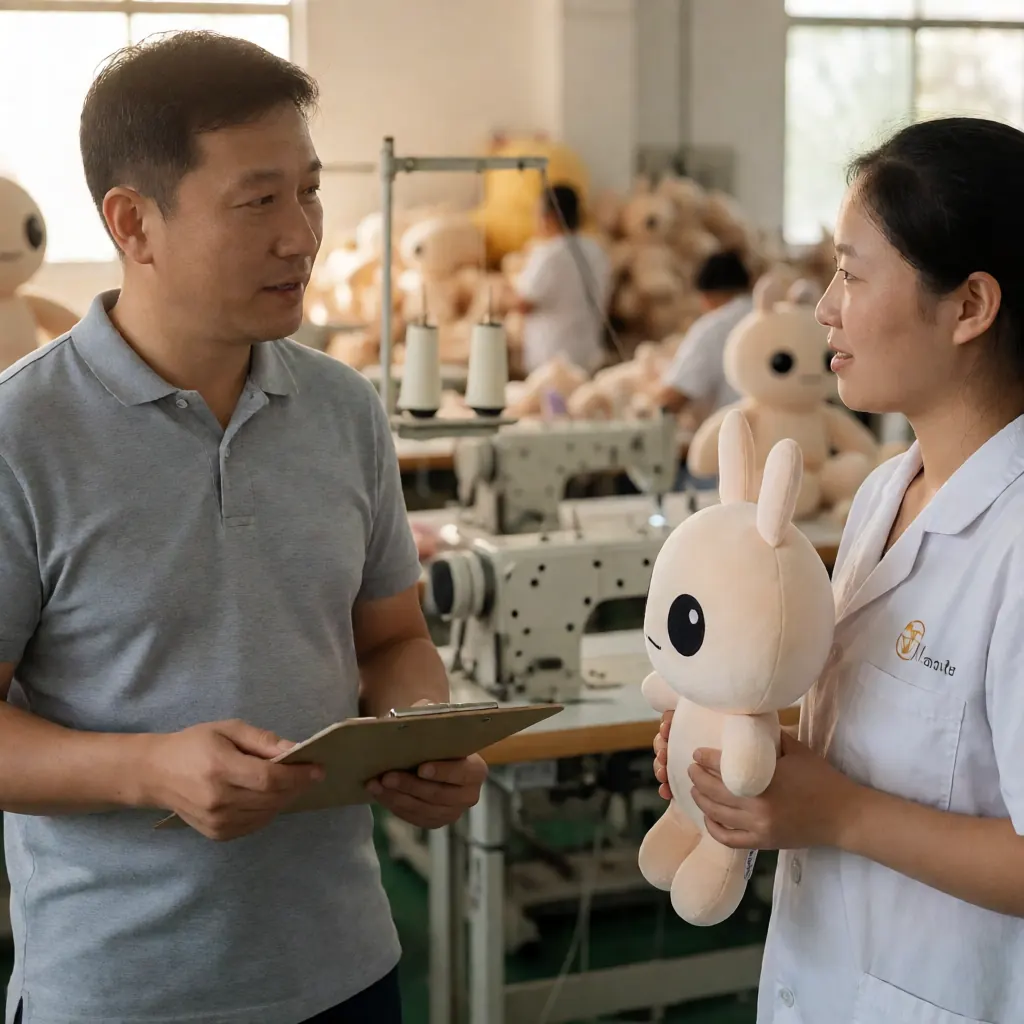
Most buyers have one day on site because flights and trade show schedules dictate it. The sequence below front-loads the checks that cannot be faked.
- Hour one: the seam test. Open three samples from different production lots, photograph the internals, and compare the electronics module to the approved construction drawing.
- Hour two: the document room. Ask for the certificate of conformity, the current test report, the module approval, the cell specification and the data flow diagram. Photograph every page, and note which requests were met and which were deferred.
- Hour three: the line walk. Follow one plush toy from cutting through to cartoning. Time each station, count work in progress, and check whether the flow is one piece at a time or a pile of hundreds waiting for electronics.
- Hour four: the audio and ageing test. Ask to hear the acoustic test run, and ask to see the ageing or burn-in station where units play for a defined period before packing.
- Hour five: the commercial close. Minimum order by colour, material lead time, tooling and sample cost if any, payment terms, and the exact name of the person responsible for quality and the person responsible for compliance after you leave.
Leave with three artifacts: a signed first-article inspection photo set, a list of missing documents with dates promised, and one named contact for each of quality, compliance and logistics. Factories that work with small brands get requests like this weekly and will not be surprised. Factories that do not will spend the day trying to redirect you to the showroom, and that is a useful answer too.
Five red flags that should end the conversation
Some findings are negotiable, and some are not. These are the ones to walk away from.
- The certificate of conformity is generic and lists multiple rules in a single line. Section 1110.11 requires each rule, ban, standard or regulation to be identified separately, so a single line means nobody read the rule.
- The factory writes your privacy policy for you and asks you to publish it unchanged. The notice and consent obligations in 16 CFR Part 312 belong to the operator, which is the brand. A factory that owns your privacy wording also owns your liability.
- Substitutions happen after the order is placed and are confidentially disclosed in the shipping documents. This is the single most common cause of a good product failing a lab test on the second shipment.
- Nobody can tell you the firmware or wake-word model owner. If the chain of custody of the voice stack is unclear, you cannot answer a single data protection question from a retailer.
- The MOQ is low, but the fabric dye-lot minimum is high and nobody mentioned it until after the deposit. The economics of small batch production live in the fabric, so a factory that hides the fabric floor is not really offering a low minimum order.
Bringing the sample home: field validation before mass production
Factory vetting ends at the factory gate, but the risk does not. Before committing to a production order, put twenty to fifty golden samples into real homes for two to four weeks. Recruit parents in your target market, not your own staff, and ask them for four specific data points: wake-word success in a noisy room, battery life under normal play, how often the toy is left charging overnight, and whether the child still plays with it after week two.
This stage answers questions no lab can. A sample that scores well in the demo room but fails in a living room with a television on is telling you that the microphone placement or the wake-word threshold needs work, and that change is cheap before tooling and expensive after. It also gives you something the certificate cannot: a documented user trial you can show a retailer buyer who asks why they should trust a new supplier.
Frequently asked questions
How long does a proper factory audit take?
One full day on site is enough for a small or mid-sized factory if you arrive with a document list and the intention to open samples. The preparation takes longer than the visit: decide your non-negotiables, send the question list a week in advance, and ask for the compliance package by email so you know what will be missing before you spend a day travelling.
Do I need to visit if I am buying through an agent or trading company?
You still need to know who physically makes the product and who signs the test reports. An agent can coordinate the visit, but the construction drawing, the first-article inspection and the certificate of conformity must trace to a factory, not a trading entity. Ask for the factory's name, address and the manufacturing licence details behind the quotation.
What if the factory has no experience with AI toys?
Most plush factories are excellent at textiles and new to firmware, batteries and data. That is workable if the factory is honest about the boundary and partners with a competent module supplier. It is not workable if the factory presents an outsourced voice stack as its own in-house technology, because then no one in the chain is accountable when the platform changes its terms.
Where should the compliance discussion sit in the negotiation?
Before price. Certification cost is a function of scope, and scope is a function of design decisions that are cheap to change early: whether the toy is age-graded for under three years, whether the battery is sealed or replaceable, whether the microphone is a defined module with its own documentation. Fixing scope first turns the compliance package into a purchase order line instead of a surprise.
Next step
If you are evaluating plush AI toy suppliers for a 2027 range, the fastest way to shorten this process is to send a specification and get a construction-level response: module drawing, material list, lead time breakdown by stage and a compliance document list. That response tells you more about a factory than a showroom tour ever will.
Related reading from our factory team: AI learning tablet versus AI companion robot, which SKU to import in 2027, what the MEMS microphone spec really tells you about voice performance, and where AI toys store your child's voice and how parents control it. If you are importing into Germany, our TÜV and GS certification guide for AI plush imports covers the additional German requirements.
For the plush toy bill of materials side of the same decision, see our sister site's breakdown of how a 300-unit low MOQ AI plush toy breaks down by cost and what tooling and mold cost looks like for AI toys in 2026.
Sources
Regulatory references used in this article, so your quality and compliance team can verify every point:
- 16 CFR Part 1250, Safety Standard for Toys, including the ASTM F963-23 incorporation in section 1250.2
- 16 CFR Part 312, Children's Online Privacy Protection Rule, sections 312.3, 312.4 and 312.6
- 16 CFR Part 1110, Certificates of Compliance, section 1110.11 certificate content
- The Toy Association, industry safety and compliance resources
- European Commission, toys sector and EU toy safety rules
- Spielwarenmesse, 2 to 6 February 2027, Nuremberg, for meeting suppliers in person
Comments
No comments yet — be the first to share your thoughts.