2026-11-02
One Retailer Collapse Killed 23 Toys: A Recall-Proof Exit
November 2026 · Channel Risk, Recall Liability and Compliance Planning for B2B Toy Buyers
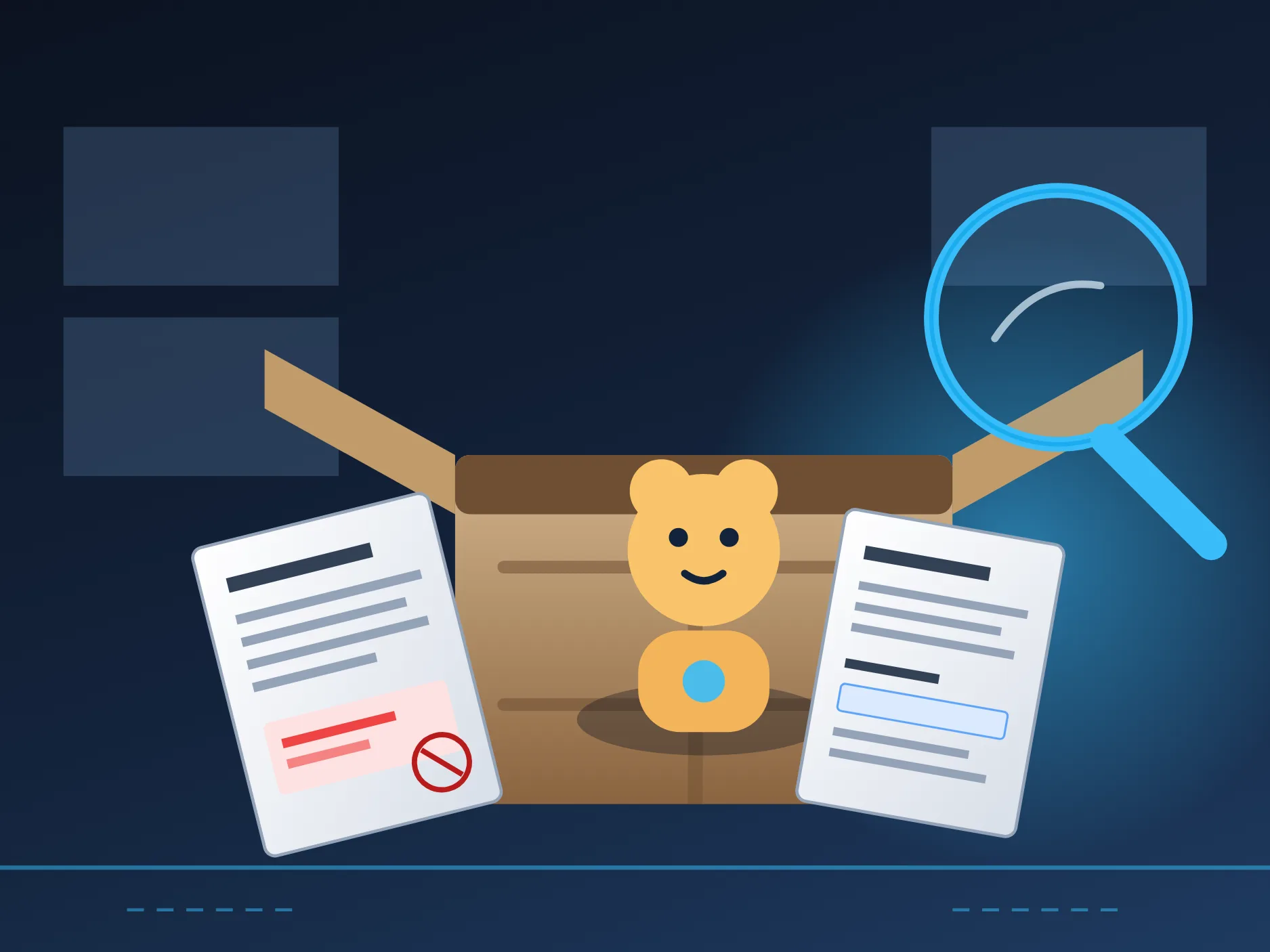
There is a version of a toy recall that no quality manual prepares you for. The product complies. The samples passed. The certificate of conformity was signed years ago. Then the retailer that ordered the tooling, paid for the packaging and pushed you into a 12-month forecast is gone, and somewhere in a third-party warehouse sits a shipping container of toys carrying your brand name, your safety data and your CPSC registration — with nobody left to sell it, distribute it or take it back.
That is not a hypothetical. When Toys R Us wound down in the United States in 2017 and 2018 and in Germany in 2018, the direct obligations in 15 U.S.C. 2064(b) were not winding down with them. The statute attaches to the manufacturer, distributor and retailer of a product distributed in commerce, and it does not expire when a shopping list of creditors changes. A brand whose only US channel disappears overnight inherits the fieldwork: returns, claims, inventory that nobody will sell, and a certificate that has to be produced within 24 hours of a CPSC or CBP request.
If you import or own an AI toy brand, a distributor failure is not a sales problem you can absorb with a credit note. It is a recall problem you are legally holding. The sections below explain exactly which duties survive the failure, which ones move to you, and how to put them into a contract and a certificate that a customs broker can actually file.
The importer of record never reads the retailer's bank statement
US law allocates consumer product duties at the point of distribution, not at the point of success. The Consumer Product Safety Act makes it unlawful to sell, offer for sale, manufacture for sale, distribute in commerce or import a consumer product that is not in conformity with an applicable consumer product safety rule (15 U.S.C. 2068(a)(1)). It is equally unlawful to sell or distribute a product that is subject to voluntary corrective action taken by the manufacturer in consultation with the CPSC and publicly notified, or that is subject to an order under section 2061 or 2064 (15 U.S.C. 2068(a)(2)).
Read that twice, because the second limb is the one retailers rely on and importers forget. A product can be perfectly compliant and still be unlawful to sell because the manufacturer has already told the CPSC of a defect and agreed to a corrective action. Your channel partner does not get a grace period because a container is already in its DC. Neither do you.
The reporting duty itself is set out in 15 U.S.C. 2064(b): every manufacturer, distributor and retailer of a consumer product distributed in commerce who obtains information that the product contains a defect which could create a substantial product hazard, or creates an unreasonable risk of serious injury or death, or fails to comply with an applicable consumer product safety rule or any similar rule, standard, ban or regulation under a law enforced by the CPSC, must report it immediately.
Three details matter for toy brands preparing for a channel exit:
- "Distributor" and "retailer" are listed parties. A brand owner that buys finished goods and sells them to a chain is a distributor. A 3PL that takes title for fee is a retailer. The obligation does not wait for the factory to act.
- "Immediately" is not defined by your legal team's availability. CPSC's recall handbook has long described immediate reporting as meaning notification "within 24 hours" of obtaining the information — the agency's own guidance, not a statutory safe harbour but the practical benchmark regulators apply.
- A channel partner's liquidation does not reset the clock. If you learn of a defect during an inventory reconciliation or a returns audit triggered by a retailer's insolvency, that is the moment the duty attaches, not the date the SKU stops selling.
For AI toys the defect class is wider than most brands assume. A voice-enabled plush that records and stores audio, a companion robot with a lithium cell that swells, a learning tablet whose companion app forwards children's speech to a vendor in another jurisdiction — each of these has produced its own category of corrective action. The defect does not need to be mechanical. When a firmware update makes a toy log conversations it should not, the CSPC route is a substantial product hazard claim, not a software bug.
According to an evaluation by CPSC, toys are subject to a large number of rules, and a toy that fails any of them can be subject to an expense record; the importer of record — not the factory — is the party on the certificate and the party the agency contacts first.
What a supplier exit actually does to your recall exposure
When a channel partner shuts down or liquidates, four things happen at once, and each one increases rather than reduces your exposure.
Inventory becomes orphaned but remains in commerce. Liquidators sell everything, including returns, shelf pulls and cancelled purchase orders. Toys that were never defective become "as-is" merchandise sold without the retail partnership that maintained the after-sales channel. When a customer complaint arrives six months later, it arrives at your customer service inbox, because the retailer no longer exists.
Retailer-owned compliance paperwork goes dark. Shops maintain their own copies of certificates of conformity, test reports and declaration information. When a buying office closes, so does the archive. If your own records are incomplete, you have to reconstruct test data for a batch that was manufactured two or three years earlier. The recordkeeping duties under 16 CFR Part 1110 require certificates to be made available for inspection within 24 hours on request (16 CFR 1110.13(c)).
The marketing asset reverts to the brand. AI toys have a second dependency most plush products do not: an app, a cloud account and a voice content library. If a retailer funded the companion app and the app contract was in the retailer's name, a shutdown can leave end users with a toy that no longer talks. Nothing in the CPSC regulations prohibits that, but it converts a dead product into a support and reputational event — and, for a subscription-based product, into a revenue failure you will have to explain to the bank that financed the tooling.
Tooling and inventory financing become claims. A factory with unpaid tooling has a legitimate claim; the mold is often its collateral. If your liquidating partner was the contracting entity for a tool with a $12,000 to $24,000 up-front cost, you may find yourself buying your own product's tooling twice — once from the toolmaker, once from a liquidator's asset schedule.
None of that is bad luck. Each of the four is addressable in a contract or in an operating procedure. The rest of this article works through both.
The five clauses a toy supply agreement has before it can survive an exit
Standard OEM purchase orders are written for a world where both parties stay solvent. The following five clauses are the ones that convert a collapsed channel into a recoverable event rather than an existential one. They are written for the buyer's side of the table, because in an AI toy supply relationship the buyer — the brand — is usually the importer of record and the smaller balance sheet.
- 1. Compliance ownership with a named backup. The agreement should state who is the finished product certifier, who holds the test reports, and who is responsible for filing certificate data at the time of entry. Under 16 CFR 1110.13(a)(1), a finished product certified for import must have its certificate data elements eFiled in ACE at the time of entry, or at the time of filing the entry and entry summary if both are filed together. Where the product is imported by mail, the data must be entered in CPSC's Product Registry before the product arrives in the United States. A clause that says "the factory holds all certificates" is not enough: specify that copies must sit in the buyer's own document system, in a format the buyer can retrieve without asking anyone.
- 2. A certificate hand-over trigger tied to failure, not to dispute. Language along these lines: on any insolvency event, assignment for the benefit of creditors, liquidation, or 60-day payment default of either party, the manufacturer must deliver complete test reports, certificate data elements, golden samples, firmware images and voice content manifests to the buyer within ten business days.
- 3. Titled inventory and control of returns. Who owns returns, dead stock and shelf pulls, and who pays to reprocess them, must be agreed before an exit — not during a liquidator's schedule. For AI toys also name the data owner of any audio collected by a returned unit, because a returned recording toy is an end-of-life data problem disguised as cardboard.
- 4. Purchase-money and tooling rights registered, not assumed. Record the tool ownership in writing, and where the factory or a third-party toolmaker holds a security interest, require a written acknowledgement that the buyer owns the tool and can remove it. A tool that cannot be removed without a settlement is a tool you will re-buy.
- 5. A wind-down support obligation with a price. Specify a minimum support ladder: firmware update period, app support period, spare parts availability and the cost of reflashing cancelled stock. AI toys sold into an exiting channel are sold with a support clock that should start on the date of manufacture, not the date the retailer closes.
The point of these clauses is not adversarial drafting. It is that in a recall event, the CPSC asks the importer for information it may not physically possess. Your contract is how you get it back.
Where a bankruptcy actually redirects the risk
Buyers often assume that a supplier's or retailer's bankruptcy puts everything on hold. US bankruptcy law does the opposite: it gives the debtor's estate powers that reset much of the contractual certainty the buyer built.
Section 365 of Title 11 allows the trustee, subject to court approval, to assume or reject any executory contract or unexpired lease. That is what permits a retailer in Chapter 11 to walk away from purchase obligations, or a factory to abandon a supply contract, subject to the standards in section 365(b).
Payment strength in a collapse is even more asymmetric. Section 503(b) of Title 11 lets an entity file a request for payment of an administrative expense, and the allowed category covers the actual, necessary costs and expenses of preserving the estate, including wages and commissions for services rendered after the commencement of the case (11 U.S.C. 503(b)(1)(A)(i)). Read carefully: services rendered after the case began. Goods manufactured and shipped before the petition is another unsecured general claim, and it joins the queue.
Two practical consequences for a toy buyer:
- A finished-goods claim is usually an unsecured claim. If your factory has a container ready and the buyer's channel partner is the contracting party, you cannot rely on your PO to get paid just because the goods were finished. Your realistic recovery is often the liquidation value of the inventory — and that inventory may not be yours.
- Recalls are not automatically paused by a rejection. Rejecting a purchase agreement does not dissolve the statutory duty to report a defect to the CPSC, because 15 U.S.C. 2064 applies to the manufacturer, distributor and retailer of a product distributed in commerce. The estate can reject contracts; nobody can reject the obligation to report a hazardous product that is already in the field.
Section 365(b) is worth knowing precisely because it is the one part of the mechanism a buyer can use: the trustee may only assume a contract in default after curing the default or providing adequate assurance that it will be promptly cured, compensating the other party for actual pecuniary loss, and providing adequate assurance of future performance. Negotiating a condition that the contract can only be assumed with the buyer's consent to assignment is not hostile; it is standard.
The certificate is your recall defence, and it is far more detailed than a logo
Most importers treat the children's product certificate as a page in a compliance binder. It is actually the artefact the CPSC and customs will ask for first, and the information required is more specific than a factory often prepares by default.
Under 15 U.S.C. 2063(a)(2), before importing for consumption or warehousing or distributing in commerce any children's product subject to a children's product safety rule, the manufacturer and private labeler must submit sufficient samples to an accredited third-party conformity assessment body for testing, and issue a certificate based on that testing that certifies compliance with each applicable children's product safety rule.
The certificate content, per 16 CFR 1110.11(a), must include:
- at least one unique identifier — GTIN, model number, registered number, serial number, SKU, UPC or alternate identifier — plus a description sufficient to match the finished product to the certificate;
- each consumer product safety rule, ban, standard or regulation to which the product is certified, identified separately;
- the finished product certifier's name and full contact details;
- the individual maintaining records, with name and contact details, which may be a position title provided the position is always staffed and responsive to CPSC;
- the date (month and year at minimum) and place of manufacture, including the manufacturer's name, street address, city, state or province, country or region, email and telephone;
- the most recent date and place of testing, including the same details for each third-party conformity assessment body on whose testing the certificate depends;
- the certifier's attestation, which under section 1110.11(a)(7) includes the statement that knowingly and willfully making a materially false or fictitious statement on the certificate is a US federal crime.
In a recall, items 5 and 6 are the ones that fail. A certificate that lists the trading company as manufacturer, or that names "Shenzhen" as the place of manufacture, cannot be reconciled with a tracking label on a carton. And the pass-through effect is severe: 16 CFR 1110.13(b) requires the certifier to furnish the certificate to each distributor or retailer, which is precisely why a retailer's collapse destroys the chain of documentary custody while the legal duty stays with you.
For AI toys there is a second certificate layer that a plush supplier rarely carries: the radio module and its wireless approvals, the battery declaration, and — for products directed to children in the US — the children's privacy obligations under 16 CFR Part 312. If a channel partner's shutdown triggers a returns programme, that programme is also a data-processing event.
The table buyers should keep in the purchase file
The comparison below is the operational version of everything above. It is not a legal opinion; it is the working summary a sourcing manager can hand to legal counsel without losing a week of review time.
Exposure matrix
Defect reporting
- What the rule requires: 15 U.S.C. 2064(b): report immediately to CPSC on a reportable defect or non-compliance, including failure to comply with a rule or ban
- Who is exposed when a retailer or factory exits: Manufacturer, distributor and retailer all named; the brand bears it publicly
- Buyer action before the exit: Keep a written defect-escalation path with a named 24-hour contact and a decision log
Selling non-compliant stock
- What the rule requires: 15 U.S.C. 2068(a)(1): unlawful to sell, distribute or import non-conforming product; (a)(2) covers product under voluntary corrective action
- Who is exposed when a retailer or factory exits: The party actually selling — often the brand or a 3PL selling orphaned stock
- Buyer action before the exit: Freeze orphaned inventory with a written hold; do not donate, resell or export without checking order status
Certification
- What the rule requires: 15 U.S.C. 2063(a)(2) third-party testing; 16 CFR 1110.11 content; 1110.13(a)(1) eFile in ACE at entry
- Who is exposed when a retailer or factory exits: Finished product certifier, plus each retailer that received the certificate
- Buyer action before the exit: Own the certificate copy, the test report and the golden sample; verify identifier (GTIN, model, UPC) matches the carton
Records on demand
- What the rule requires: 16 CFR 1110.13(c): certificates available for inspection within 24 hours on request by CPSC or CBP
- Who is exposed when a retailer or factory exits: Whoever holds records — if the retailer held them, you cannot answer
- Buyer action before the exit: Mirror all compliance files in your own system with a retrieval test you actually run
Contract in default
- What the rule requires: 11 U.S.C. 365(b): trustee may assume only after cure, compensation for pecuniary loss and adequate assurance of future performance
- Who is exposed when a retailer or factory exits: The supplier or retailer left holding an unperformed contract
- Buyer action before the exit: Draft the compliance hand-over and assumption-consent clauses now, not at the hearing
Payment priority
- What the rule requires: 11 U.S.C. 503(b)(1)(A)(i): administrative expense covers costs of preserving the estate after the case begins
- Who is exposed when a retailer or factory exits: The party with goods finished before the petition — usually unsecured
- Buyer action before the exit: Insure or finance pre-petition exposure; do not confuse a PO with security
Tooling and moulds
- What the rule requires: Written tool ownership plus the toolmaker's acknowledgement
- Who is exposed when a retailer or factory exits: The buyer who assumed it owned a tool it cannot remove
- Buyer action before the exit: Register tool rights; photograph and serialise every mould before release
Returns and data
- What the rule requires: Product-destruction and return obligations plus children's privacy duties under 16 CFR Part 312
- Who is exposed when a retailer or factory exits: The brand, because returned recording toys contain data
- Buyer action before the exit: Specify the data owner and the destruction procedure for returned units
A pre-exit audit you can finish in a week
The most useful thing a toy brand can do in November, while the 2027 order book is being negotiated, is a one-week channel-dependency audit. It is deliberately narrow, and each step produces a document rather than a feeling.
Day one — list every SKU sold through the channel at risk. For each one, record the importer of record on the entry, the certificate identifier, the manufacturing site, and whether the test report is in your system or the factory's. Any SKU where you cannot answer all four within an hour is a red SKU.
Day two — reconcile the certificate against the carton. Open one shipping carton per production run and compare the tracking label to item 5 of the certificate: the actual date of manufacture and the actual place. This single check catches more certificate defects than any legal review. Per section 1110.11(a), the manufacturing place must include the manufacturer's name and full street address, not the city of a trading company.
Day three — test the 24-hour clock. Under 16 CFR 1110.13(c) the certificate must be available for inspection immediately, meaning within 24 hours, on request by CPSC or CBP. Simulate the request: send a colleague an email asking for one specific SKU's certificate, and measure how long the answer takes and who has to be contacted. If the answer path runs through a distributor, fix the path.
Day four — map the software and content dependencies. Name the owner of the firmware repository, the app store listing, the cloud account and the voice script library. If any of those is registered to a party other than you, draft the assignment now, while the parties are still talking.
Day five — price the end-of-life liability. Estimate what it would cost to recall, receive, test, reflash or destroy stock currently in the channel. That number belongs in your 2027 pricing, not in a footnote. An importer with a recall budget that is reset annually — rather than a percentage of shipment value — can react in a week instead of a quarter.
Day six — verify the tools and the moulds. Walk the tooling schedule with photographs and serial numbers. Confirm the toolmaker's acknowledgement and the factory's written confirmation that the tool is not pledged.
Day seven — write the two-page annex. Attach it to the 2027 purchase agreements: compliance ownership, hand-over triggers, return ownership, tool rights and support clock. Two pages inserted in November is cheaper than a single recall letter in March.
Two failure patterns to watch
In our own discussions with buyers sourcing AI plush and companion robots from Guangdong, two patterns repeat so consistently that they are worth naming.
Pattern one: the design-file vacuum. The brand owns the brand name, the packaging artwork and the app, but the firmware and the voice script library sit with the factory because the factory wrote them for a 2024 programme. When the buyer changes channel or the factory loses a key customer, the product stops being maintainable. The fix is contractual immutability: source code in escrow, firmware images on a buyer-controlled repository, and a written list of every script and prompt asset shipped with the toy. The cost of this clause is normally nil at signing time and priceless eighteen months later.
Pattern two: the under-insured inventory. A two-SKU order to a retailer that represents 60 percent of volume, financed with a single letter of credit, in a tariff environment where landed cost already carries duty exposure. A shop closure converts the whole line into dead stock at exactly the point the duty is paid. Credit insurance and channel concentration limits are not procurement trivia; they are the difference between a bad year and a recall letter.
Neither pattern requires a law degree. Both require a buyer who writes the exit scenario down before the order is placed.
What to put in the 2027 purchase agreement this month
If you take one operational recommendation from this article, make it this: attach a two-page exit annex to every 2027 toy supply agreement signed before Spielwarenmesse, which runs 2 to 6 February 2027 in Nuremberg. The annex should contain exactly five paragraphs — compliance ownership and back-up custodian, a ten-day hand-over trigger on an insolvency event, a returns and data destruction clause, a registered tool-ownership acknowledgement, and a support clock that starts at manufacture.
For buyers also negotiating tariffs and customs value in the same window, our guides on the real BOM inside a $29.99 AI plush and on customs valuation, assists and tooling cover the cost side of the same document. For the factory side of the question — what evidence a real OEM can produce on request rather than on apology — the one-day AI toy factory audit sets out the eleven documents that should be in your file before a container sails.
A recall does not care whether your trading partner is solvent. Build the record, name the owner, register the tool and keep a 24-hour answer path. The rest is a Tuesday.
Sources
- 15 U.S.C. 2063 — Product certification and labeling, including third-party testing for children's products and certificate issuance — https://www.law.cornell.edu/uscode/text/15/2063
- 15 U.S.C. 2064 — Substantial product hazard reporting duty on manufacturers, distributors and retailers — https://www.law.cornell.edu/uscode/text/15/2064
- 15 U.S.C. 2068 — Prohibited acts, including (a)(1) non-conforming product and (a)(2) products under voluntary corrective action — https://www.law.cornell.edu/uscode/text/15/2068
- 16 CFR Part 1110 — Certificates of compliance: section 1110.11 certificate content, section 1110.13 availability and eFile at entry — https://www.law.cornell.edu/cfr/text/16/1110.11 and https://www.law.cornell.edu/cfr/text/16/1110.13
- 11 U.S.C. 365 — Executory contracts and unexpired leases, including assumption conditions in subsection (b) — https://www.law.cornell.edu/uscode/text/11/365
- 11 U.S.C. 503 — Allowance of administrative expenses, including (b)(1)(A)(i) costs of preserving the estate — https://www.law.cornell.edu/uscode/text/11/503
- 16 CFR Part 312 — Children's Online Privacy Protection Rule, including section 312.4 notice and consent requirements — https://www.law.cornell.edu/cfr/text/16/312.4
- CPSC, Recall Handbook — agency guidance on immediate reporting and recall procedures — https://www.cpsc.gov/Business--Manufacturing/Recall-Guidance
- Spielwarenmesse, Nuremberg, 2 to 6 February 2027 — show calendar for the 2027 order window — https://www.spielwarenmesse.de
Comments
No comments yet — be the first to share your thoughts.