2026-11-19
Lab Accepted, Rule Not: The 5-Minute Scope Check in 2027
November 2026 · A US lab-scope audit for importers, brand owners, IP licensors and channel buyers shipping AI plush, companion robots and educational toys into the United States in 2027

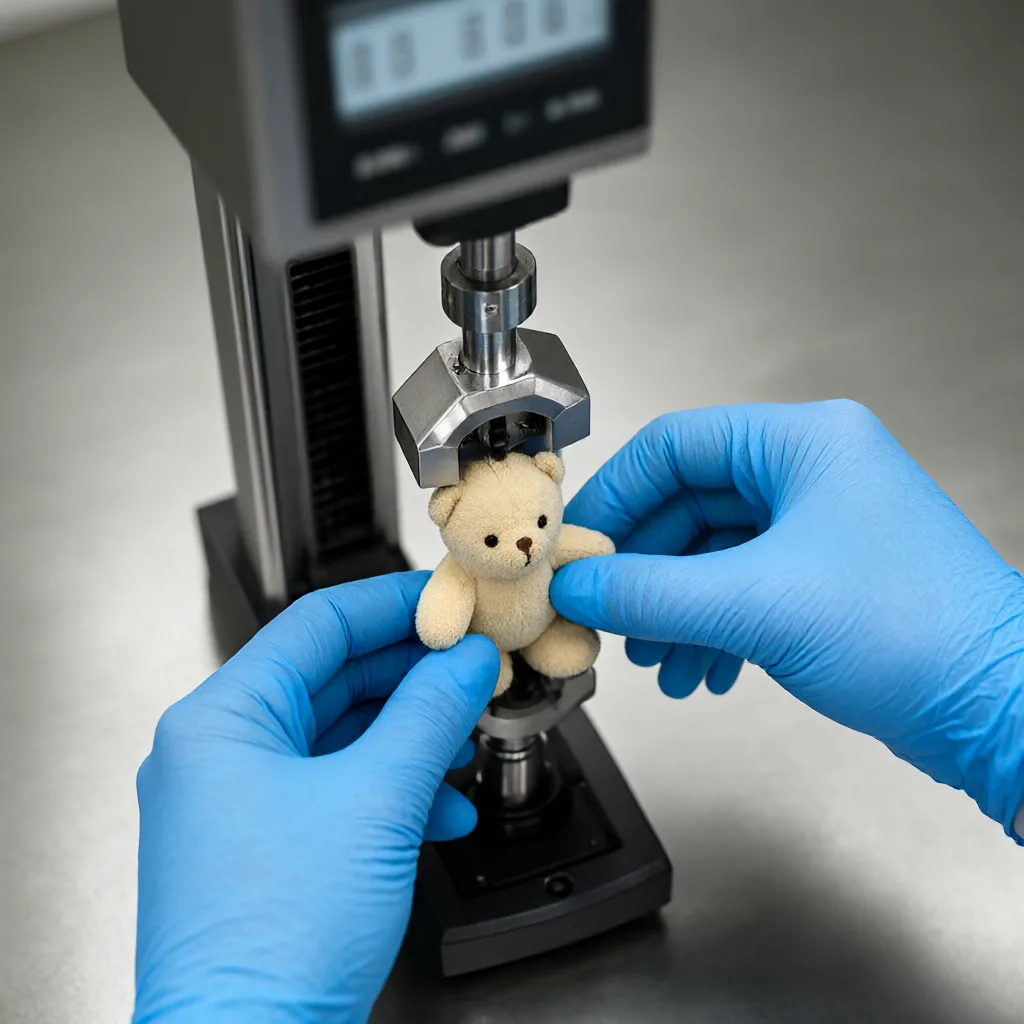
A laboratory can test a plush toy perfectly, and the certificate it signs can still be worthless, because the lead it was accredited to run may not include the rule that decides whether the toy is legal. On 1 November 2026 we ran the same five-minute check against nine test reports that buyers had forwarded to us during October sourcing calls. Three of the nine reports cited a laboratory whose stated scope did not cover the specific children's product safety rule named on the report's conclusion line. Two of those three were for orders that had already shipped. None of the nine buyers had been asked by their supplier to look at scope at all: they had been sent a PDF with a logo, a number and a green tick.
Note: the count above is from our own inbound files and is not a market statistic. The regulation itself is the point, and it is public: 16 CFR Part 1112 defines what the CPSC accepts, and 16 CFR 1107.26 puts the recordkeeping duty on the manufacturer, not on the factory and not on the lab.
This article is written for the people who sign the purchase order rather than the test request: importers, brand owners, IP licensors approving 2027 lines and channel buyers auditing suppliers before Nuremberg. It covers what a CPSC acceptance actually consists of, what "scope" means in practice, the eight documents to request before you accept a report, how the same question is answered in the EU and what that means for a dual-market certification file, and it closes with the five-year clock that starts the day the toy was tested. Nothing here is legal advice; every rule below is linked at the end.
What CPSC acceptance of a lab actually is
The Children's Product Certificate that your importer issues is only valid if the underlying testing was done by a CPSC-accepted third party conformity assessment body. 16 CFR 1112.3 defines that body as a laboratory, and the acceptance is rule by rule, not product by product. A lab does not become "CPSC approved" as a company. It becomes accepted for a particular children's product safety rule, and only within the scope for which its accreditation has been accepted.
That distinction is the whole article in one sentence, so it is worth spelling out with the mechanics:
- The lab must be accredited to ISO/IEC 17025 by an accreditation body that is a signatory to the ILAC Mutual Recognition Arrangement, under 16 CFR 1112.13(a)(2)(i).
- The lab submits CPSC Form 223, on which it attests whether it is independent, firewalled or governmental, under 16 CFR 1112.11 and 1112.13(a)(1).
- The CPSC accepts that accreditation for a defined scope, and publishes the accepted laboratories and the scope of each acceptance on its website, under 16 CFR 1112.19.
- The acceptance can be suspended under 16 CFR 1112.45 or withdrawn under 16 CFR 1112.47, and 1112.55 provides for publication of adverse actions.
Nothing in that list involves the toy. Every step is about the laboratory. The toy's compliance argument begins after the lab has already been qualified, which is why a buyer who checks the report before the lab is checking the second half of the chain first.
Three ways a test report looks fine and is not
The reports we reviewed failed the same way twice, and both failures are visible on page one if you know what to look for.
The first is scope mismatch. A report concludes "meets the requirements of ASTM F963-23" and includes a phthalates line. The acceptance on the CPSC website lists the lab for a specific set of rules; if 16 CFR 1307 is not among them for that lab and that address, the phthalates data in the report is not section 14 testing, whatever the cover sheet says. The report is still a laboratory report. It is not a basis for a Children's Product Certificate.
The second is subcontracting. 16 CFR 1112.23(a) allows a CPSC-accepted lab to subcontract section 14 work only to another CPSC-accepted lab whose acceptance covers the subcontracted scope, and 16 CFR 1112.25(a)(2) requires the prime contractor's report to identify clearly which tests were performed by the subcontracting lab, with the subcontractor's report available to the CPSC on request. A report that shows one logo and one signature while the tensile work was farmed out to a non-accepted lab in a second city is not a paperwork nit. Under 1112.23(a) the CPSC treats a breach of that rule as compromising the integrity of the testing process, which is a ground for withdrawal of acceptance for the prime lab as well.
The third, which is a manufacturer's failure rather than a lab's, is the material change. 16 CFR 1107.23(a) requires new samples, new third party testing and a new certificate whenever a design or manufacturing change, including a change in the sourcing of component parts, could affect compliance. Swapping a plush fabric supplier mid-season is a sourcing change. Swapping the rechargeable cell in a companion robot is a sourcing change. The certificate on file from the spring does not cover the unit that ships in December.

The five-minute scope check, step by step
This is the check we ask every supplier to complete and sign before we accept a report into a 2027 file. It takes five minutes and it requires nothing from the factory except the PDF.
- Read the conclusion line of the report. Write down the exact rule or standard number as printed, for example 16 CFR 1500.53 for use and abuse testing, 16 CFR 1303 for lead in paint, 16 CFR 1307 for phthalates or ASTM F963-23 as accepted by the Commission.
- Read the lab's legal name and the address printed on the report, not the sales office address on the cover.
- Open the CPSC list of accepted third party conformity assessment bodies under 16 CFR 1112.19 and find that legal name.
- Check that the rule from step 1 appears in the scope accepted for that laboratory, and check the date the listing was last updated.
- If the report names a subcontractor anywhere, repeat steps 2 to 4 for the subcontractor, because 1112.23(a) does not let the prime lab lend its acceptance to a second lab.
- If the listing is absent for that rule, stop. Ask the lab for the acceptance, not the supplier, because the supplier cannot create it.
- Record the check in the certificate file with the date and the name of the person who performed it.
The reason to record step 7 is 16 CFR 1107.26(b): the records must be available to the CPSC either in hard copy or electronically, and they may be maintained in another language only if they can be provided immediately and translated accurately into English within 48 hours of a request, or within a longer period negotiated with CPSC staff. A scope check that exists only in someone's memory is not a record.
What a buyer should hold, and for how long
The retention question is settled in US federal regulation and it is shorter than most supply chain teams assume, which changes how a certificates repository should be designed.
- Children's Product Certificate: a copy per product, with the product clearly identifiable and distinguishable from others, under 16 CFR 1107.26(a)(1).
- Third party certification test records: separate records for each manufacturing site, under 1107.26(a)(2), which means a second factory making the same SKU is a second record set.
- Periodic testing records: a periodic test plan and results, or a production testing plan with results plus periodic results, or ISO/IEC 17025 laboratory results plus periodic results, under 1107.26(a)(3). 16 CFR 1107.21 sets the default interval for general periodic testing at at least once a year.
- Representative sample records: how many samples were selected and the procedure used, plus the basis for inferring that the products made during the interval comply, under 1107.26(a)(4).
- Material change records: descriptions of every change in design, process or component sourcing, with the tests run and the values, under 1107.26(a)(5).
- Undue influence records: the training materials and the signed training attestations for every employee trained on the procedures, under 1107.26(a)(6) and 16 CFR 1107.24(b)(1).
All six sit for five years from the date the record was created or the test conducted, under 1107.26(b). The number that surprises buyers is not five years for the file; it is five years for the laboratory, because 16 CFR 1112.25(a)(1) separately requires the accepted lab to keep all test reports and technical records for at least five years from the date of testing, and 1112.25(a)(3) requires it to keep the version of the report it sent to the customer even when it differs from the technical record. That is good news for an importer who loses a report: the lab must still have it. It is bad news for an importer who hopes the lab quietly lost an unfavourable one.
The comparison table, written as a row-by-row check
The table below compares how the United States and the European Union handle the same six questions. It is written as one line per row so that it can be pasted into a supplier questionnaire without reformatting.
Question 1: who may test. US: a CPSC-accepted third party conformity assessment body under 16 CFR Part 1112, accepted rule by rule. EU: a notified body for the modules that require third party involvement, or self-declaration under the applicable module of the toy safety framework.
Question 2: what the lab must be accredited to. US: ISO/IEC 17025 by an ILAC-MRA signatory, under 16 CFR 1112.13(a)(2)(i). EU: the accreditation requirements of Regulation (EC) No 765/2008, with the notified body published in the NANDO database.
Question 3: how the buyer checks the lab. US: the CPSC list of accepted laboratories and scopes, published under 16 CFR 1112.19. EU: the NANDO list of notified bodies with the product categories and modules in the notification.
Question 4: whether a lab may subcontract. US: only to another CPSC-accepted lab covering that scope, and the subcontract must be identified in the prime report, under 16 CFR 1112.23(a) and 1112.25(a)(2). EU: subcontracting is permitted only under the notified body's accreditation and is named in the conformity assessment, with the notified body remaining responsible.
Question 5: the certificate. US: a Children's Product Certificate issued by the importer or US manufacturer, based on section 14 testing, with the required content under 16 CFR Part 1110. EU: an EU declaration of conformity drawn up by the manufacturer, with the technical documentation under the applicable decision on technical documentation.
Question 6: how long the file is kept. US: five years for the manufacturer's records under 1107.26(b) and at least five years for the lab's technical records under 1112.25(a)(1). EU: ten years after the toy was placed on the market for the technical documentation, with the exact period set by the applicable framework decision, which is why the dual file should follow the longer of the two.
Note: the EU column summarises the structure, not the operative text of each article. A dual-market file should be built to the longer retention period, ten years, because the US five-year rule is a floor rather than a target for a product that is also sold in Europe. Our article on the ten-year certification file walks through that EU side in detail: https://niokyar.com/blog/toy-certification-file-traceability-eu-us-2027
Where the 2027 calendar makes this urgent
Two dates in the 2027 sourcing calendar put a lab-scope question on the critical path earlier than the production schedule suggests.
The first is the Spielwarenmesse window, 2 to 6 February 2027. Most buyers arrive in Nuremberg with a sample and a quote, and leave with a specification sheet. What they do not usually carry is a scope-verified test report for the exact SKU that will be ordered, because the SKU does not exist until the consumer unit is finalised. That is a reasonable position in February and an expensive one in April, when the mould cut-off forces the specification to freeze. Our companion piece on the sample calendar and the lab queue explains the sequencing: https://niokyar.com/blog/spielwarenmesse-2027-sample-calendar-lab-queue
The second is the certification file that has to survive the year after delivery. A recall decision is made on the record, not on the product, and the difference between a contained field action and a broad one is often whether the importer can produce a scope-correct report for the specific factory and the specific lot. Our article on the supplier exit plan covers the other half of that record: https://niokyar.com/blog/us-toy-recall-supplier-exit-plan-2027
For importers tracking the broader 2027 schedule alongside these, the certification file and the lab scope question should be answered in the same review meeting, because they share a single owner.

Audits, form 223 and the two-year clock
A scope listing is a snapshot, and the snapshot moves. Under 16 CFR 1112.35(b)(1), every accepted lab must submit CPSC Form 223 for audit purposes no less than every two years, and 1112.35(b)(3) requires the CPSC to notify the body in writing at least 30 days before the deadline. Under 1112.13(a)(2), a new Form 223 must be submitted whenever the information on it changes.
For a buyer the practical consequence is simple: a scope screenshot in a 2025 certificate file is not evidence for a 2027 shipment. Re-check the listing at the moment you place the production order and again when the report arrives, and note both dates. A lab that moved address, changed ownership, added a rule to its scope or lost one will have an updated listing, and a report that cites an old acceptance number is a report from before that change.
The adverse action routes matter too, because they are what a listing change usually looks like. 16 CFR 1112.43 allows denial when required documentation is not completed within 30 days of a deficiency notice or when material information is false or misleading. 1112.45 allows suspension of acceptance while a lab fails to cooperate with a section 14 investigation. 1112.47(a) makes undue influence by a manufacturer, private labeler, governmental entity or other interested party a ground for withdrawal of acceptance, and 1112.47(b) and (c) cover failures against the subpart B and subpart C requirements. On the manufacturer's side, 16 CFR 1107.24 requires written procedures, training, signed attestations, immediate notification of any attempt to hide or exert influence over test results, and a route for employees to report allegations confidentially, with the CPSC accepting such reports by email at labaccred@cpsc.gov under 1112.49(a).
Read those two provisions together and the risk to an importer becomes concrete. If a sourcing manager exerts commercial pressure to obtain a passing result, the exposure is not only to the lab. It is to every certificate that lab has issued on the importer's products, because the remedy is withdrawal of the acceptance the certificates depended on.
Component part testing does not remove the scope question
Component testing is often sold to buyers as a cost saving, and 16 CFR Part 1109 does permit it. 16 CFR 1109.5(a) allows a finished product certifier to certify based in whole or in part on passing component part tests, and 1109.12 and 1109.13 permit reliance on component part testing for lead content and for phthalates in children's toys, provided the requirements of 1109.5 are met and the inaccessibility determination is based on an evaluation of the finished product.
Two conditions trip up suppliers who use this route.
The first is that the component testing still has to come from a CPSC-accepted third party conformity assessment body for lead content, as 1109.12 states in terms. A paint or plastisol test report from a lab outside the acceptance system does not support certification, even if the method and the detection limit are identical.
The second is the inaccessibility argument. Lead and phthalate component reliances depend on which parts are inaccessible under section 101(b)(2) of the CPSIA and 16 CFR 1500.87, and 1109.12 and 1109.13 both tie that determination to an evaluation of the finished product. A plush toy with a sewn-in speaker module is accessible or not accessible depending on how that module is enclosed in the finished toy, not on how it arrives from the electronics supplier. An AI plush program that changes from an internal pouch to a hook-and-loop closure in the middle of a season has changed the inaccessibility argument without changing a single component.
What to put in the supplier agreement
The clauses that fix this problem are short, and they belong in the supply agreement rather than in a quality annex, because the failure is commercial before it is technical.
- The supplier warrants that all section 14 testing is performed by a CPSC-accepted laboratory whose scope covers each rule named in the report, and provides the acceptance reference for each rule at the time of testing.
- The supplier notifies the importer within 48 hours of any change in laboratory, any change in the test address, any change of subcontractor and any change in the status of the lab's acceptance.
- The supplier notifies the importer of any material change under 16 CFR 1107.23 before the first shipment of the changed product, and does not ship until the new certificate is issued.
- The supplier delivers the record set in 16 CFR 1107.26 in English or with an immediate translation capability, given the 48-hour translation window in 1107.26(b)(2).
- The supplier confirms in writing that the undue influence procedures of 16 CFR 1107.24 are in place, with training attestations available on request.
- The importer retains the right to re-verify scope at any time and to reject a report at the importer's cost if the scope check fails.
Our clause library for 2027 AI toy supply agreements covers the wider contract: https://niokyar.com/blog/ai-toy-supply-agreement-compliance-clauses-2027
The short version
The certificate is not the evidence. The evidence is the certificate plus the scope acceptance of the specific laboratory, for the specific rule, at the specific address, on the date the test was run, plus the record that shows someone checked. Everything else is a logo on a cover sheet.
For a 2027 line, three dates make the work real: the scope check at order placement, the scope check at report receipt, and the two-year Form 223 audit clock on the laboratory that runs through 1112.35. For a dual-market file, the retention period is ten years, not five, because the EU documentation period is longer and the US five-year period is a floor rather than a goal.
The five-minute check costs nothing and does not require the factory's cooperation, only its PDF. Running it before the order is signed is the cheapest insurance available in an AI toy program.
Sources
- 16 CFR Part 1112, Requirements Pertaining to Third Party Conformity Assessment Bodies, eCFR: https://www.ecfr.gov/current/title-16/chapter-II/subchapter-B/part-1112
- 16 CFR Part 1107, Testing and Labeling Pertaining to Product Certification, eCFR: https://www.ecfr.gov/current/title-16/chapter-II/subchapter-B/part-1107
- 16 CFR Part 1109, Conditions and Requirements for Relying on Component Part Testing or Certification, eCFR: https://www.ecfr.gov/current/title-16/chapter-II/subchapter-B/part-1109
- 16 CFR Part 1110, Certificates of Compliance, eCFR: https://www.ecfr.gov/current/title-16/chapter-II/subchapter-B/part-1110
- Consumer Product Safety Act, section 14, 15 U.S.C. 2063, Cornell LII: https://www.law.cornell.edu/uscode/text/15/2063
- CPSC, third party conformity assessment body listing and Form 223 resources: https://www.cpsc.gov/Business--Manufacturing/Testing-Certification/Lab-Accreditation
- 16 CFR 1500.87, children's products containing lead, inaccessible component parts, eCFR: https://www.ecfr.gov/current/title-16/chapter-II/subchapter-C/part-1500
- EU Regulation (EC) No 765/2008 on accreditation and market surveillance, EUR-Lex: https://eur-lex.europa.eu/legal-content/EN/TXT/?uri=CELEX:32008R0765
Comments
No comments yet — be the first to share your thoughts.