2026-11-18
A 60 mm Toy Carton: Where 2.38 mm Type Decides Compliance
November 2026 · A US labelling type-size audit for importers, brand owners and channel partners shipping AI plush, companion robots and educational toys
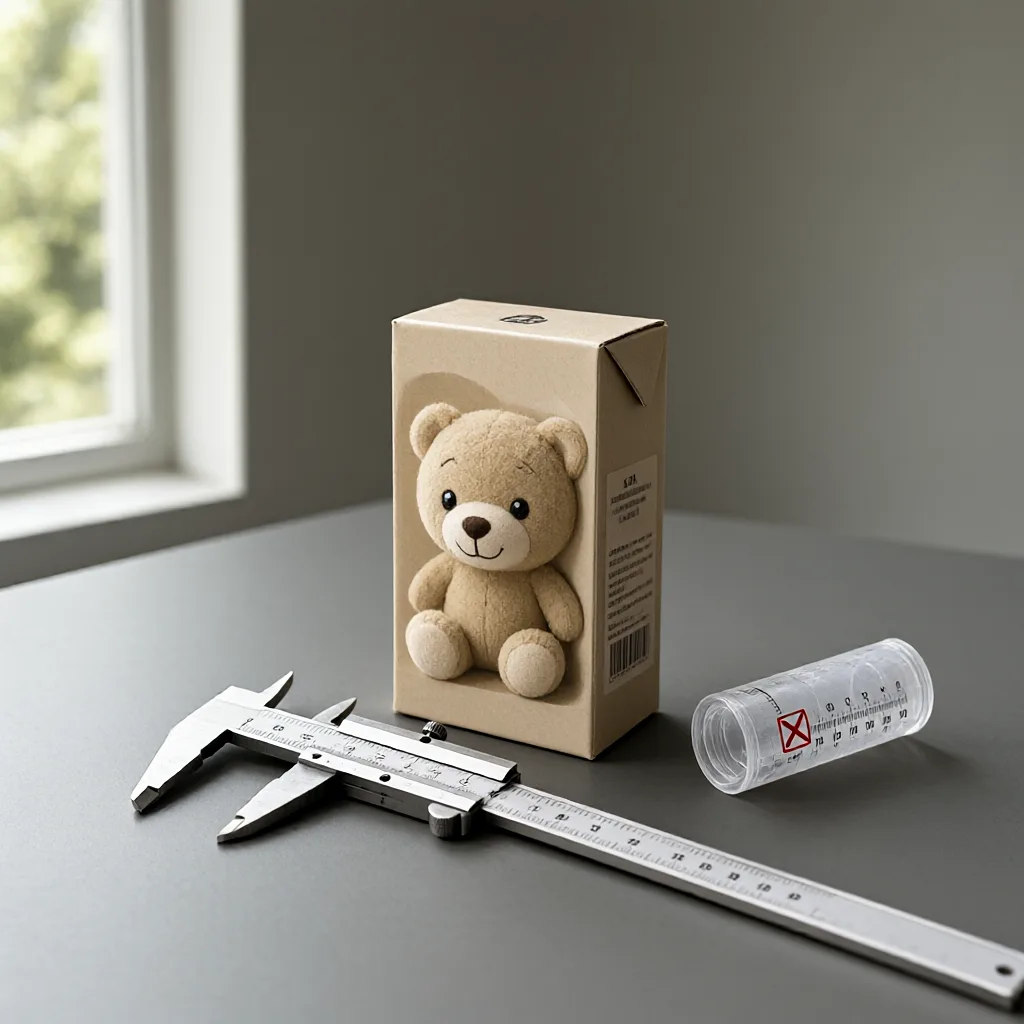
A toy carton that is 55 mm tall can be fully compliant and still fail, because the regulation that decides whether it fails is not about the toy. It is about the height of the printed capital letters. 16 CFR 1500.121(c) sets a minimum type size for cautionary material based on the area of the surface the warning is printed on, and 16 CFR 1500.19(d) applies that same rule to the choking-hazard warnings on children's toys. On a large carton the rule is easy. On a 60 by 80 mm blister card or a small plush carton, the smallest legal size for "WARNING" is 1.19 mm, and the smallest legal size for the words "CHOKING HAZARD" is 1.59 mm. Fewer than 3 mm separate a pass from a misbranded article.
This article is written for importers, brand owners, IP licensors and channel buyers scheduling 2027 lines, and for the packaging engineers who actually set the dielines. It walks through the exact text of the rule, converts the fractions into millimetres, shows the arithmetic on three real carton sizes, explains why the number of fonts a factory owns decides whether a small format is possible at all, and closes with the audit sheet we ask suppliers to sign before a packaging proof leaves the building. Nothing here is legal advice; the authority is the regulation itself, linked at the end.
Note: all figures below are taken from the eCFR text of 16 CFR Part 1500 in force on 18 November 2026. Where we convert inches to millimetres we round to the nearest 1/100 mm, which is the precision a prepress operator can actually hold.
What 16 CFR 1500.121(c) actually says
Three sentences in the regulation do most of the work.
The first defines the measurement. Type size "refers to the height of the actual printed image of each upper case or capital letter as it appears on the label." It is not the point size in the layout file, it is not the font's nominal size, and it is not the height of the line box. It is the rendered cap height of the capital letters on the printed board.
The second sets the table. Cautionary labelling must meet "the minimum size requirements in table 1", and table 1 is indexed by the area of the principal display panel in square inches, not by the physical size of the toy.
The third fixes a ratio. Under 16 CFR 1500.121(c)(3), "the ratio of the height of a capital or uppercase letter to its width shall be such that the height of the letter is no more than 3 times its width." A font squeezed to 90 percent horizontal scale to make a long warning fit will quietly violate this, and a font stretched to 70 percent horizontal scale will do the same on the other axis.
Two more rules sit on top. Under 1500.121(c)(4), the signal word and the statement of principal hazard "shall be in capital letters", so the two most important lines on the label are both all caps and both carry the biggest minimum size. And under 1500.121(c)(2)(ii), the requirement applies to "all cautionary statements appearing on any display panel", which means a side panel of a carton carries its own table lookup, calculated on that panel's own area.

The table, converted to millimetres
Table 1 of 16 CFR 1500.121(c) has six area brackets. Here it is with the fractions converted, because most factories work in millimetres and most buyers send PDF proofs to factories that work in millimetres.
- Panel area 0 to 2 sq in (0 to 12.90 cm2): signal word 3/64 in, equal to 1.19 mm. Statement of hazard 3/64 in, equal to 1.19 mm. Other cautionary material 1/32 in, equal to 0.79 mm.
- Panel area over 2 to 5 sq in (12.90 to 32.26 cm2): signal word 1/16 in, equal to 1.59 mm. Statement of hazard 3/64 in, equal to 1.19 mm. Other material 3/64 in, equal to 1.19 mm.
- Panel area over 5 to 10 sq in (32.26 to 64.52 cm2): signal word 3/32 in, equal to 2.38 mm. Statement of hazard 1/16 in, equal to 1.59 mm. Other material 1/16 in, equal to 1.59 mm.
- Panel area over 10 to 15 sq in (64.52 to 96.77 cm2): signal word 7/64 in, equal to 2.78 mm. Statement of hazard 3/32 in, equal to 2.38 mm. Other material 1/16 in, equal to 1.59 mm.
- Panel area over 15 to 30 sq in (96.77 to 193.55 cm2): signal word 1/8 in, equal to 3.18 mm. Statement of hazard 3/32 in, equal to 2.38 mm. Other material 5/64 in, equal to 1.98 mm.
- Panel area over 30 sq in (over 193.55 cm2): signal word 5/32 in, equal to 3.97 mm. Statement of hazard 7/64 in, equal to 2.78 mm. Other material 3/32 in, equal to 2.38 mm.
Note: the table defines type size as "the minimum height of printed image of capital or upper case letters", and the column for other cautionary material exists because that material may be printed on a different panel from the principal display panel. When it is, 1500.121(c)(2)(iii) says the type size of that material "is determined by the area of the panel on which it does appear." A single table lookup for the whole carton is wrong.
Under 1500.121(c)(1), area is not the portion of the surface covered with ink. It is "the area of the side or surface of the immediate container, or of the side or surface of any outer container or wrapping, that bears the labeling designed to be most prominently displayed", and "this area is not limited to the portion of the surface covered with labeling; rather, it includes the entire surface." For a rectangular carton where one whole side is the principal display panel, the area is "the product of the height times the width of that side." For a cylindrical or nearly cylindrical container, the area is "40 percent of the product of the height of the container times its circumference."
The choking-hazard line: 1500.19 borrows the same table
The choking-hazard warnings do not have their own type-size table. They inherit this one through 16 CFR 1500.19(d), which states that "the requirements of 16 CFR 1500.121 relating to the prominence and conspicuousness of precautionary labeling statements for hazardous substances shall apply to any labeling statement required under 1500.19(b) and (f)", with stated clarifications.
The clarifications matter, and three of them change the design.
Classification: under 1500.19(d)(2), "the words WARNING or SAFETY WARNING required by section 24 of the FHSA shall be regarded as signal words", and under 1500.19(d)(3), "the statement CHOKING HAZARD shall be regarded as a statement of the principal hazard." That single sentence means the words CHOKING HAZARD are held to the statement-of-hazard column, which is one step larger than other cautionary material in every bracket except the first two.
Layout: under 1500.19(d)(1), the statements "shall be blocked together within a square or rectangular area, with or without a border. This means that the statements must appear on at least two lines." They must be separated from all other graphic material "by a space no smaller than the minimum allowable height of the type size for other cautionary material", or else enclosed in a border line. And "this means that such statements shall appear on a solid background", which is the sentence that kills the popular translucent warning band printed over a photograph.
Language: under 1500.19(d)(1), "all labeling statements required by 1500.19(b) and (f) shall be in the English language." A multilingual carton is welcome, but the English set has to be there, at the required size, in the required block.
Which warnings apply to which age band is set out in 1500.19(b): a toy or game for children at least three and under six that contains a small part; a latex balloon or a toy containing one; a small ball for children three and older, and a toy for children three to under eight containing a small ball; and a marble, with the same age structure. "Small part" is defined in 1500.19(a)(5) as an object that "fits entirely within the cylinder shown in Figure 1 appended to 16 CFR part 1501" when tested under 1501.4(a) and 1501.4(b)(1).
Three cartons, three different answers
Take the three formats that dominate a 2027 plush and electronic toy line.
Small plush cube carton, front face 60 by 80 mm. Area is 48 cm2, equal to 7.44 sq in. That sits in the over-5-to-10 bracket. Signal word 2.38 mm, statement of hazard 1.59 mm, other cautionary material 1.59 mm. If the toy is a three-to-six product containing a small part, the print block must read WARNING at 2.38 mm and CHOKING HAZARD at 1.59 mm, with "Small parts. Not for children under 3 yrs." at 1.59 mm.
Blister card, front face 90 by 120 mm. Area is 108 cm2, equal to 16.74 sq in, in the over-15-to-30 bracket. Signal word 3.18 mm, statement of hazard 2.38 mm, other material 1.98 mm. The card is only 40 percent larger in linear terms than the cube, but the signal word grows by a third and the body text by a quarter.
Shelf-ready gift box, front face 200 by 250 mm. Area is 500 cm2, equal to 77.5 sq in, above 30 sq in. Signal word 3.97 mm, statement of hazard 2.78 mm, other material 2.38 mm. On this box the typesetting is comfortable and the failure mode changes from legibility to placement, because the block also has to stay clear of the marketing copy by at least the other-material height.
That is the cost trap in one line: the smaller the pack, the smaller the legal type, and the harder the type is to set. Small packs are where the rule bites, and small packs are exactly what e-commerce and gifting channels ask for.

Why 2.38 mm is a factory problem, not a designer problem
A warning at 2.38 mm capital height is roughly a 3.3 point typeface in cap-height terms, because cap height is typically 70 to 72 percent of point size in a humanist sans. At that size, two things happen.
First, flexo and offset printing on recycled carton board begin to fill in the counters of letters. The counters of an E, an A and an R are the small enclosed spaces, and at 0.6 mm stroke width the ink can close them. The proof looks fine at 1016 dpi on a screen and the printed box shows a convincing WARNING that reads as WARNING only to someone who already knows what it says.
Second, and more expensive, the printer may not have a typeface whose cap height ratio can hit the number. Under 1500.121(c)(2)(ii), "when an item of labeling is required to be in a specified type size, all upper case, or capital, letters must be at least equal in height to the required type size, and all other letters must be the same style as the upper case or capital letters." A wide display face with a low cap-height ratio, or a hand-lettered style that the brand team loves, cannot be scaled into a comfortable solution within a small block. It has to be swapped for a text face, and the swap changes the block width, which changes the dieline, which changes the tooling.
Practical consequence for sourcing teams: ask for the cap-height ratio of the chosen label typeface in the same email where you ask for the FSC certificate. A factory that answers "our designer will make it fit" has told you they are scaling a font horizontally, which is a 1500.121(c)(3) violation waiting for a port inspection.
The proof-and-measure procedure to run before every PO
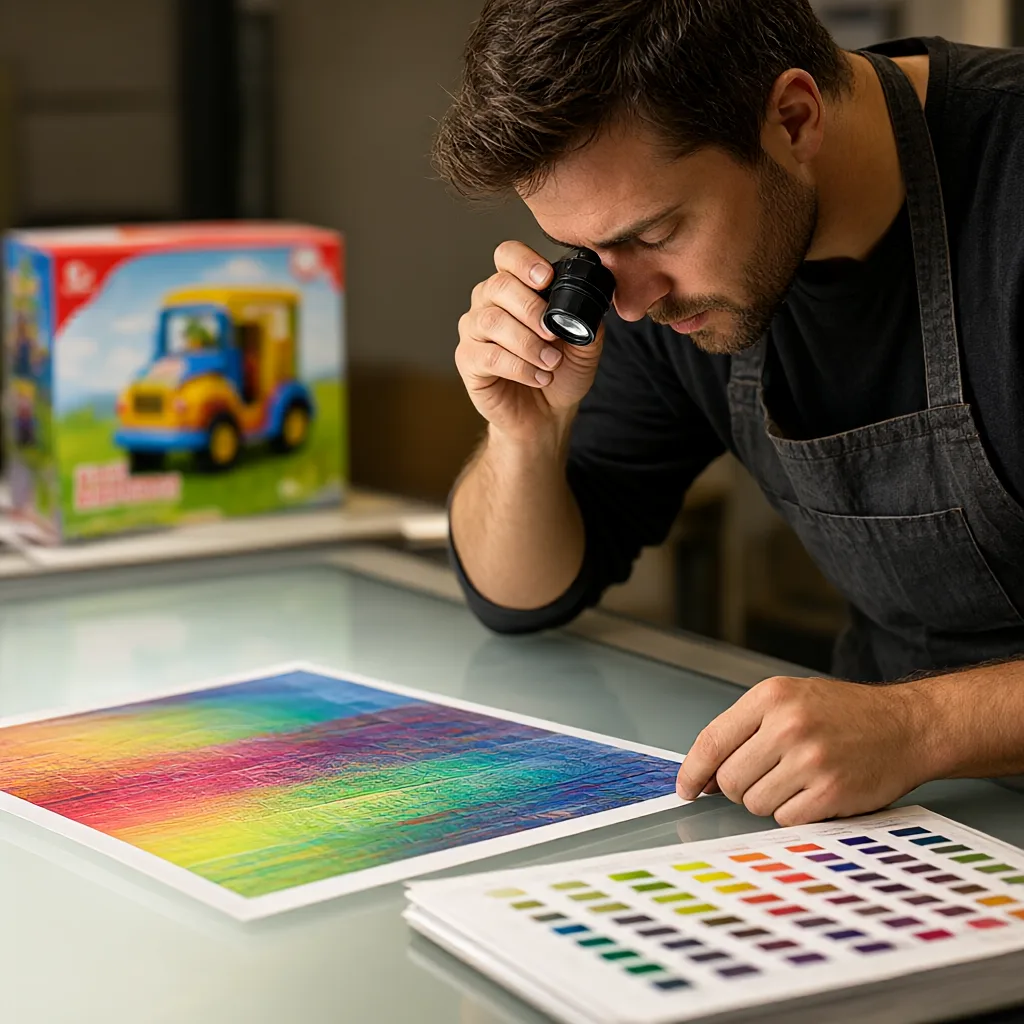
The regulation is checkable with a ruler, a loupe and a printed proof. We ask suppliers to run the following sequence and send the evidence with the first production sample. It takes about 40 minutes per SKU.
- Pull the dieline PDF and record the front-face dimensions in millimetres. Compute the area and place it in the correct bracket by comparing against 12.90, 32.26, 64.52, 96.77 and 193.55 cm2.
- Do the same for every other panel that will carry cautionary material, because 1500.121(c)(2)(iii) measures that material against the panel it sits on.
- Print a 100 percent proof on the production board stock, not on office paper. Board grade changes dot gain, and dot gain is what closes the counters.
- Measure the cap height of the W of WARNING, the C of CHOKING HAZARD, and one capital letter in the smallest body line with a caliper or a loupe with a scale. Record the three numbers against the three table values.
- Measure the width of the same letters and confirm the height-to-width ratio is no more than 3 to 1.
- Confirm the warning block is two or more lines, is on a solid background, and is separated from surrounding graphics by at least the other-material height or enclosed in a border.
- Confirm the English set is present in full even where a second and third language share the panel.
- Photograph the proof with the caliper in frame and file it. That photograph belongs in the product certification and traceability file, not in a chat thread.
Note on CE-marked production for the EU: this article covers the US federal rule only. The EU side has its own requirements for visibility and durability of warnings, and the 2025 toy regulation on the digital product passport does not replace the printed warning. We covered that separate regime in the article on Toy Regulation 2025/2509: Passport Due 2030, Data Due Now.
What this means for the 2027 line
For an import line shipping to US retailers in the summer and autumn of 2027, the type-size decision is made in the packaging art stage, which for a Nuremberg launch runs between December 2026 and March 2027, after the sample is approved and before the cartons are ordered. Two changes reduce the risk without changing the product.
Move the choking-hazard block to the largest panel on the pack. The rear panel of a 60 by 80 mm box is the same area, but the rear of a gift box is often twice the area of the front, and the table rewards area. The regulation only requires the statements to appear on the package, with the placement rules of 1500.121(b) applied to whichever display panel carries them, and 1500.121(b)(3) then requires the principal display panel to point to them with a line such as "Read carefully other cautions on the panel", set at the other-material size.
Move up one carton format. A single 5 mm increase on each side of a small pack moves a 7.44 sq in panel to 8.4 sq in, which does not change the bracket, but a move from 4.9 sq in to 5.1 sq in does, and the difference is 0.79 mm of signal word that the printer can actually hold. Run the arithmetic before the dieline is signed, not after.
For licensed products there is one more interaction. Licence style guides frequently mandate a logo lock-up with a fixed minimum size and a clear space expressed in millimetres, and that clear space competes with the warning block separation rule. Where the two conflict, the regulatory separation wins, and the licence holder usually accepts a documented adjustment when the evidence is a printed proof and the regulation citation. Related reading on how those approval gates interact with the 2027 sample calendar is in Licensed 2027 Line: 4 Approvals Before Nuremberg, and the stage at which a packaging change becomes a retail packaging submission is set out in Change a Toy's Age Grade: 5 Rules That Move and the Bill.
Important: misbranding is not a labelling nuisance. A toy whose package fails the prominence and conspicuousness requirements of 1500.19(d), which incorporates 1500.121, is a misbranded hazardous substance under 1500.19(b), and recall, refusal of admission and stop-sale exposure follow from that. The cheapest audit in the supply chain is the one that happens at the proof stage with a caliper.
Frequently asked questions from buyers
Is the type size the font size? No. Under 1500.121(a)(2)(v) and (c)(2)(i), it is "the height of the actual printed image of each upper case or capital letter as it appears on the label." A 5 pt sans usually prints a cap height well under 1.6 mm, so specifying a point size is not the same as complying.
Does the same size apply to the sticker on the polybag? The table follows the panel, and the sticker is its own display panel. Measure the sticker's own dimensions and use the matching bracket.
Can we use a condensed font to fit longer text? Only within the 3 to 1 height-to-width limit of 1500.121(c)(3), and the type size itself cannot shrink to make room.
Does the digital product passport replace the printed warning in the EU? No. The passport carries data; the printed warning remains a physical label requirement.
Sources
- 16 CFR Part 1500, eCFR current text, section 1500.121 Labeling requirements; prominence, placement, and conspicuousness, including Table 1 of paragraph (c): https://www.ecfr.gov/current/title-16/part-1500/section-1500.121
- 16 CFR 1500.19 Misbranded toys and other articles intended for use by children, including the prominence and conspicuousness clarifications at paragraph (d): https://www.ecfr.gov/current/title-16/part-1500/section-1500.19
- 16 CFR Part 1501 Method for identifying toys and other articles intended for use by children under 3 years of age which present choking, aspiration, or ingestion hazards because of small parts, including section 1501.4 test procedures and Figure 1: https://www.ecfr.gov/current/title-16/part-1501
- 16 CFR 1500.83 Exemptions for small packages, minor hazards, and special circumstances: https://www.ecfr.gov/current/title-16/part-1500/section-1500.83
- 16 CFR 1500.128 Label comment, the route for informal Commission comment on a proposed label: https://www.ecfr.gov/current/title-16/part-1500/section-1500.128
- Federal Hazardous Substances Act, 15 U.S.C. 1261 to 1278, as amended by the Consumer Product Safety Improvement Act: https://uscode.house.gov/view.xhtml?path=/prelim@title15/chapter30&edition=prelim
Comments
No comments yet — be the first to share your thoughts.