2026-11-08
Spielwarenmesse 2027: The 20 November Mould Cut-Off
slug: spielwarenmesse-2027-sample-calendar-lab-queue title: "Spielwarenmesse 2027: The 20 November Mould Cut-Off" description: "The Nuremberg fair opens 2 February 2027. A 5-week tool, a 2-3 week lab queue and the Christmas shutdown put the last usable tool cut at 20 November 2026. A 12-week sample calendar for AI toy buyers." date: 2026-11-08 status: published tags: - Spielwarenmesse 2027 dates - toy sample lead time calendar - 16 CFR 1107.21 periodic testing - pre-production toy sample before tooling - AI toy third party lab turnaround image: /assets/img/blog/20261108-labqueue01.webp seo_title: "Spielwarenmesse 2027 Sample Calendar: Tool Cut-Off 20 Nov" seo_desc: "Working back from the 2-6 February 2027 fair: a 20 November 2026 mould cut-off, the December lab queue, and the four decisions due before the Christmas shutdown."
November 2026 · Sample Calendars, Lab Queues and Tooling Decisions in the 12 Weeks Before Spielwarenmesse

The Nuremberg show opens on Tuesday 2 February 2027 and closes on Saturday 6 February. Backwards from that Tuesday, the last day a new mould is cut is 20 November 2026. That is not an estimate. It is arithmetic on dates you can check yourself: a five-week tool that a factory cannot compress, two to three weeks of third-party test lab turnaround, the sourcing window that sits between the two, and the public holidays that close every one of those links.
This article is written for importers, brand owners, IP licensors, educational toy buyers and channel partners who will carry prototypes and pre-production samples into Nuremberg and who expect to leave with purchase orders. It is about the twelve weeks that decide whether the sample in your hand at the booth is a toy anyone can order, or a working model that the buyer's compliance team quietly re-classifies as a non-sellable exhibit. It is also about the work that does not happen during the fair, because the fair is not a week off from compliance. It is ten days in which your buyer, your seller and your factory are all in the same building and nobody is testing anything.
The week-by-week calendar backwards from 2 February
The dates below are weeks, not aspirations. Each one names the last moment a task can finish if the next link is going to hold. If a link slips, it is the next link that costs, so the order matters more than any single date.
- Week of 9 November 2026. Approve the industrial design freeze. Any feature that changes mechanical geometry after this week is a tool change, not a sample change. This is also the last week in which a new mould can be cut and still hand you a tested sample before the fair.
- Week of 16 November 2026. Issue the tooling release and place the hardware order for the sample set: PCB, battery, speaker module, microphone module and the shell parts. Component lead times on the electronic side usually exceed shell lead times, so the electronics order is the one that sets the critical path.
- Week of 23 November 2026. First article out of the tool. Measure the wall sections, the seam gaps and the battery compartment tolerances, and photograph every one of them against the drawing. Anything wrong this week is a tool adjustment. Anything wrong in December is a new tool.
- Week of 30 November 2026. Ship the sample set to the third-party lab. Book the lab slot in this same week, not later, because lab queues are the least visible of all the delays and the December queue is the one nobody documents until it is too late.
- Week of 7 December 2026. Lab testing runs. This is the week in which the test report is either issued or a failure is raised. A failure raised in early December can still be answered with a mechanical fix if the fix does not touch the tool. A failure raised after 18 December usually cannot.
- Week of 14 December 2026. Hardware and firmware integration freeze. The version of firmware you demonstrate at the fair has to be the version the lab evaluated, or the audio output, radio module and battery discharge profile the lab wrote into the report no longer describe the thing on your table.
- Weeks of 21 and 28 December 2026. Hong Kong and mainland China observe the Winter Solstice on 21 or 22 December, Christmas Day on 25 December and the first weekday after Christmas, and the New Year holiday on 1 January. Factories run partial shifts, labs post skeleton crews and the people who could answer a technical question are on leave. The only things done in these two weeks are things that can be done without a decision.
- Week of 4 January 2027. Final sample build and packing. The sample case has to be packed as a commercial product, which means the box, the label, the warning texts and the instruction leaflet in the languages you are claiming, not a poly bag.
- Week of 11 January 2027. Documents closed: test report, certificate data sheet, EU declaration of conformity draft, and the internal answer sheet your staff will use when a buyer asks for the report number.
- Week of 18 January 2027. Sample suitcase shipped by courier. Nuremberg is not a same-week courier destination in January, and a shipment held in customs is a sample that is not in the hall.
- Week of 25 January 2027. Build and rehearse the booth sample set, and hold a dry run of the buyer conversation with the person who will actually answer the compliance questions. The lab report is not a talking point; the three sentences you can say about it are.
- Week of 1 February 2027. The fair. Nothing is built, tested or approved this week.
The pattern is simple. Everything expensive happens before 14 December, everything cheap happens after. A design change in week one costs a CAD file. The same change in the week of 7 December costs a tool and a new lab report, and the lab report cannot be scheduled until the tool exists.
The tooling clock nobody quotes in writing
The five-week figure for a new mould is a planning number, not a rule. It is useful precisely because it is conservative. What matters more is the list of things that must be true before the tool clock starts, because each of them is a day a buyer can lose without noticing.
- Tool drawing approval. The factory builds what the drawing says. If the drawing is not signed, the five weeks have not started, whatever the purchase order says.
- Draft analysis. A plush toy with a hard plastic sound module housing goes wrong at the corners, where a two-degree draft turns into a point defect that shows through the fabric. Draft is a CAD decision and it costs a week if it is discovered after the tool is cut.
- Colour and texture samples. The first shot out of a new tool is usually the wrong colour and the wrong surface finish. The colour sample has to be approved before the first shot, not after.
- Textile template confirmation. If the plush body is sewn around the hard parts, the sewing template changes with the tool. A sewing template revision after the first article is a week on its own.
Note the sequencing trap here, because it is the single most common way a fair sample arrives late. Buyers approve a tool drawing and a plush pattern in the same email, and the factory starts the tool on day one but only starts the pattern on the day the fabric arrives. The two clocks are not the same length, and the shorter one does not get to decide when the article is finished.
There is a cheaper alternative worth naming, because it is what most buyers actually bring to Nuremberg. A pre-tooling sample set built with 3D printed or CNC-machined shell parts has the right geometry and the wrong surface, and it can be in a lab within two weeks. It will not give you a report you can certify against, because a machined part is not a production part, but it will find the failures that are geometric: seam gaps, small parts, accessible sharp edges, battery compartment access. If the mould is not going to be cut before December, a machined sample set plus a lab exploration report is a better use of November than an untested promise.
Why the December lab queue is the real deadline
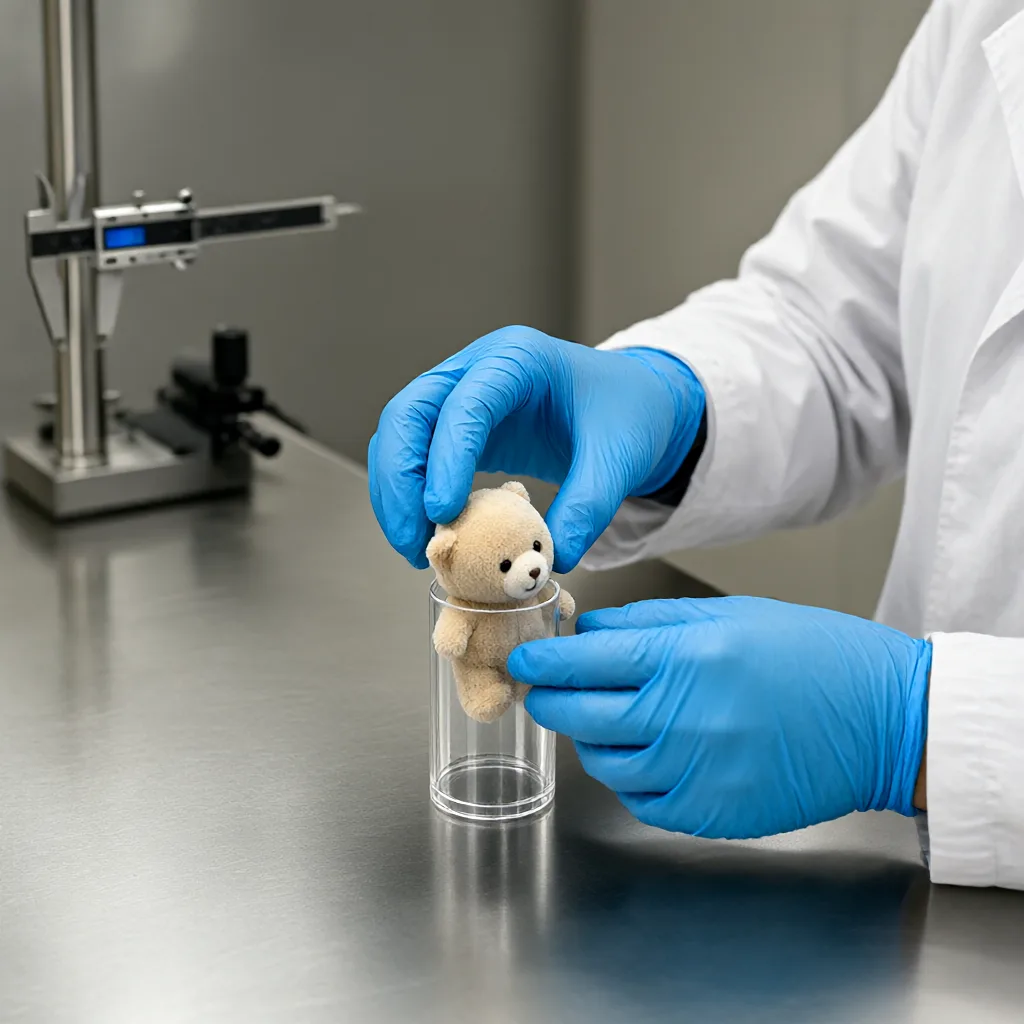
The lab is the only link in the chain that the factory does not control, and it is the link buyers budget the least time for.
The US side has two separate deadlines that are easy to conflate. Under 16 CFR 1107.21(b), periodic testing of a children's product must be performed at least once a year; under 1107.21(c), a manufacturer operating a production testing plan still has to send samples to a third-party conformity assessment body for periodic testing at least once every two years. Both routes end at the same place: a qualified third-party laboratory, accredited for the specific rule under 16 CFR Part 1112, producing a report that the certificate under 16 CFR 1110 depends on. A lab that is accredited for the toy safety standard is not automatically accredited for lead in paint under 16 CFR 1303, and the certificate has to list each rule separately.
The EU side has its own clock. Under Directive 2009/48/EC the manufacturer draws up the technical documentation and carries out the conformity assessment before placing the toy on the market, and the harmonised standard EN 71-1 is the test method a lab will use to support presumption of conformity for mechanical and physical properties. The declaration of conformity is issued by the manufacturer, not by the lab, which means the factory's document and your file have to agree line by line before the box closes.
Three practical rules follow.
- Book the slot, do not book the report. Ask the lab for a test start date in writing, not a delivery date. The delivery date is derived from the start date and the start date is the scarce resource in December.
- Test the production configuration. A report issued on a sample with a different battery model, a different radio module or a different firmware build is a report that describes a product you are not selling, and a reviewer who reads the bill of materials against the report will find it.
- Give the lab the full drawing set with the sample. Labs are not design reviewers by contract, but a lab that has the drawing will tell you when a measured dimension is outside the drawing tolerance, and that is exactly the information you need in the first week of December and not in the last week of January.
Fair samples versus shippable samples: the comparison that matters
Most buyers carry two different objects into Nuremberg without naming the difference. Writing the difference down in the sample brief is what turns a fair conversation into a purchase order.
- Legal status. A fair-only display sample may be a prototype that has not been certified; a shippable sample is a production-representative unit whose test report supports the certificate. The fair sample is an exhibit. The shippable sample is merchandise.
- Age grading. A display prototype shown to a trade audience for evaluation purposes is not a toy placed on the market with an age claim. The moment the same object is offered for sale to retailers with a 3 plus label, the intended-user-age analysis under 16 CFR 1501.2(b) applies to the label, the listing and the packaging.
- Test coverage. A fair sample needs a geometry check and a safety exploration. A shippable sample needs the report that names every rule on the certificate, under an accredited lab, with the production configuration.
- Firmware. A fair sample can run a demo build. A shippable sample runs the build the lab evaluated, because the audio output level, the radio and the battery discharge behaviour were all measured on that build.
- Cost. The fair sample costs a tool, a sample build and an exploration report if you choose to test it. The shippable sample costs the same tool plus a full certification set, and re-testing if anything changed after the report.
- Deadline. The fair sample must be in the case by the week of 18 January 2027. The shippable sample must exist before your first purchase order is signed, which for a Q4 2027 delivery means the certificate has to be right long before the fair.
- Negotiation value. A fair sample with a report number attached ends the compliance argument in fifteen minutes. A fair sample without one turns the booth meeting into a promise, and promises are priced at a discount.
Note the asymmetry. The buyer who carries a certified shippable sample into the booth is not just more compliant, they are cheaper to buy from, because the retail buyer in the next hall knows that the first container will not be stopped at the port.
What to put in the sample brief
The sample brief is a one-page document the factory signs before the tool is released. Written properly, it prevents most of the December failures. Four sections are enough.
- Identity. SKU, intended user age, the market list, and the regulatory rules the sample must be tested against by paragraph, not by name. A brief that says the sample must comply with US and EU toy requirements has delegated the analysis to a factory that is not in a position to perform it.
- Configuration. Every component with its model number and supplier, down to the battery, the microphone and the radio module. The brief becomes the bill of materials the lab compares against the report, and the document that makes a silent substitution visible.
- Witness items. The dimensions the factory must measure on the first article and photograph: seam gaps, wall thickness at the battery door, the retained dimensions of any detached component, and the accessible surface of the hinge.
- Change rule. A written rule that any change to a configuration line item after the brief is re-notified, re-assessed against the rule list, and re-tested unless both parties record a written decision not to.
If you are selecting the factory in the same window, the eleven questions in the one-day AI toy factory audit are designed to be asked before this brief is written, because a factory that cannot answer them cannot hold the dates either. If the hard part of your sample is a plastic shell around a plush body, the 7 mm gap that turns a compliant plush into a recall explains the geometric failures that a first article inspection is actually looking for. And if your brief has to spell out who owns the certificate and who pays for re-testing, the nine compliance clauses an AI toy contract is missing covers the contract language that goes with the brief.
The four decisions that cannot be made in January
Everything in this article reduces to four decisions, and all four are due before the Christmas shutdown.
- Whether the toy is getting a new mould at all. A new mould means a 20 November 2026 cut-off. A soft tool or a modification of an existing mould buys a few weeks and costs surface quality, and that trade has to be accepted in writing while there is still time to choose.
- Which rules go on the certificate. This is a list of citations, agreed with the lab and the factory, not a sentence in a purchase order. The list defines the test scope, the lab accreditation needed, and the fields on the certificate.
- Who signs the certificate and who answers in 24 hours. Under 16 CFR 1110.7 the importer, the manufacturer or the private labeler may be the certifier, and under 1110.13(c) the certificate must be available for inspection immediately, meaning within 24 hours, when CPSC or CBP asks. Name the individual and a deputy before January, because in January that person is on a plane.
- What the sample at the fair is allowed to claim. A sample that claims a certified status it does not have is a promise the buyer will repeat to their retailer. Write the claim down, and make the booth team say exactly that and nothing more.
The fair is five days. The window that makes it useful is twelve weeks. The cheapest date on the calendar is this one, because the tool is still a drawing, the report is still a booking, and nothing has been paid for twice.
Sources
- Spielwarenmesse, official fair dates for the 2027 edition, 2 to 6 February 2027, Nuremberg. https://www.spielwarenmesse.de/en/
- eCFR, 16 CFR Part 1107, Testing and Labeling Pertaining to Product Certification, sections 1107.20 and 1107.21 on initial certification testing, periodic testing and production testing plans. https://www.ecfr.gov/current/title-16/chapter-II/subchapter-B/part-1107
- eCFR, 16 CFR Part 1110, Certificates of Compliance, sections 1110.7 (who certifies), 1110.11 (required content) and 1110.13 (electronic filing and availability for inspection). https://www.ecfr.gov/current/title-16/chapter-II/subchapter-B/part-1110
- eCFR, 16 CFR Part 1112, Requirements Pertaining to Third Party Conformity Assessment Bodies, including the accreditation requirements for labs testing to the toy safety standard. https://www.ecfr.gov/current/title-16/chapter-II/subchapter-B/part-1112
- eCFR, 16 CFR Part 1250, Safety Standard for Toys, section 1250.2 incorporating ASTM F963 by reference. https://www.ecfr.gov/current/title-16/chapter-II/subchapter-B/part-1250
- eCFR, 16 CFR Part 1501, Method for Identifying Toys and Other Articles Intended for Use by Children Under 3 Years of Age Which Present Choking, Aspiration, or Ingestion Hazards Because of Small Parts, sections 1501.2 and 1501.4. https://www.ecfr.gov/current/title-16/chapter-II/subchapter-C/part-1501
- EUR-Lex, Directive 2009/48/EC of the European Parliament and of the Council of 18 June 2009 on the safety of toys, including the obligations on the manufacturer to carry out the conformity assessment and draw up the technical documentation before placing a toy on the market. https://eur-lex.europa.eu/eli/dir/2009/48/oj
- EUR-Lex, Regulation (EU) 2019/1020 on market surveillance and compliance of products, the framework for how a European authority requests the technical documentation. https://eur-lex.europa.eu/eli/reg/2019/1020/oj
- Hong Kong Government, General Holidays Ordinance (Cap. 149) and the 2026 general holidays list, which fixes the Christmas, the first weekday after Christmas and New Year dates used in the calendar above. https://www.gov.hk/en/about/abouthk/holiday/
Comments
No comments yet — be the first to share your thoughts.